
There is a point in almost every customer education program where the numbers start to look impressive.
You have hundreds of videos. Dozens of courses. A growing library of help articles. New content published every month. Existing content updated regularly. Enrollments are up. The dashboard looks busy, and that busyness can be reassuring when you're trying to demonstrate the value of a small team.
But there's a problem with using volume as the primary measure of a customer education program.
More content proves that you're producing more content.
It doesn't necessarily prove that customers are learning more, using the product more effectively, or getting more value from it.
In fact, once the foundational education is covered, producing more can sometimes make the experience harder to navigate while consuming resources that would be better spent improving the things customers already rely on.
The question eventually has to change from "How much education do we have?" to "Which education actually matters?"
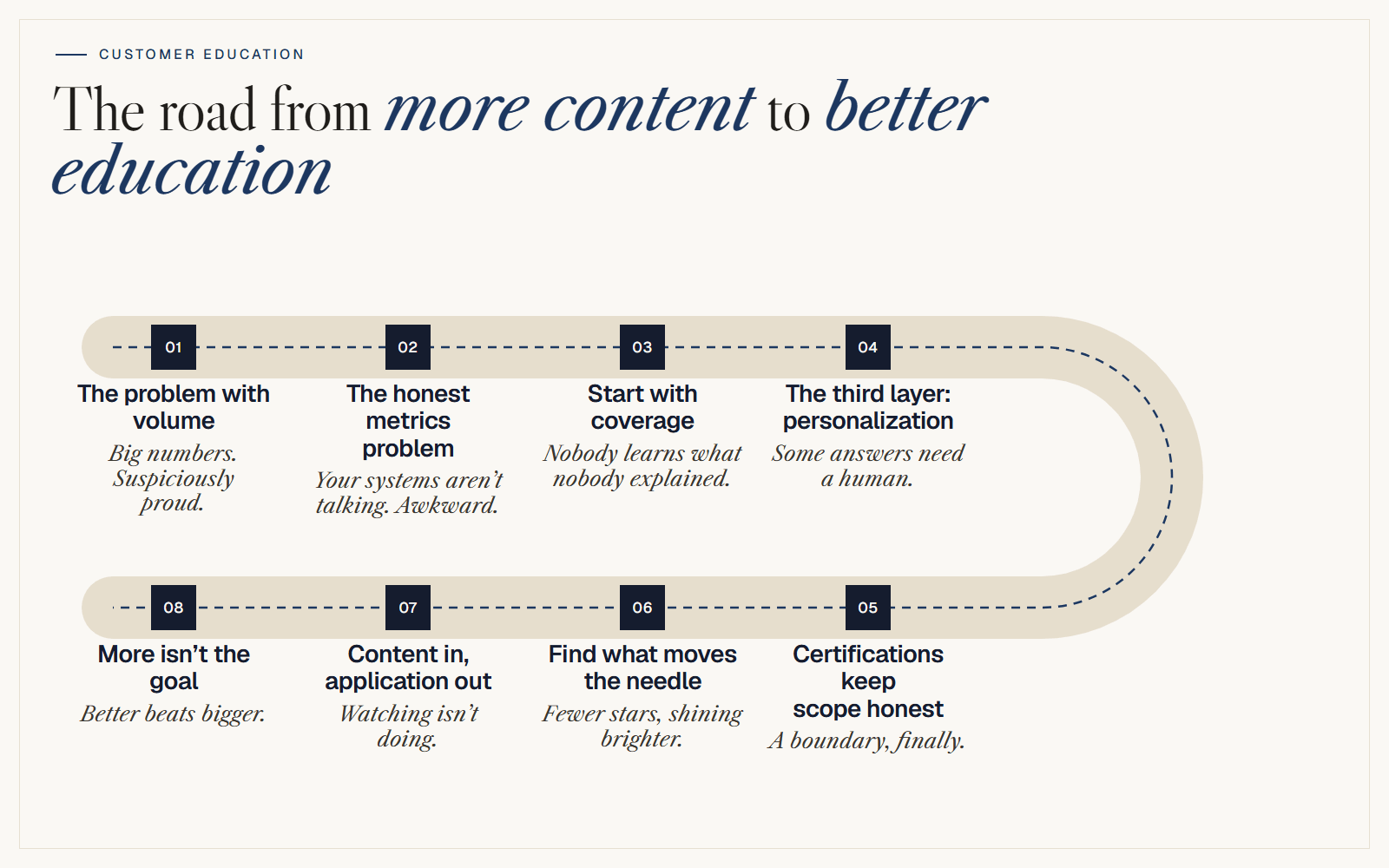
The Problem With Measuring Education by Volume
Imagine an executive dashboard showing the number of education assets currently live, the number updated this month, the number scheduled for next month, and the total number of enrollments for the year.
It's a great way to show activity.
And activity matters. Especially early in the life of an education program, you need to build enough content to cover the product, establish a consistent publishing rhythm, and give customers somewhere to go when they need help.
The problem starts when those numbers become a proxy for value.
A team can have hundreds or thousands of assets and still have gaps in the places that matter most. The most-used part of the education experience might not be a course at all. It might be the documentation portal customers visit every day because that's where they go when they need to accomplish something quickly.
If the dashboard is primarily measuring courses created, videos published, and enrollments, that daily behavior can disappear from the story.
The volume looks impressive because it is easy to count.
But counting what you've produced is not the same thing as measuring what customers actually need.
The Honest Problem With Customer Education Metrics
The next question is usually, "Okay, then how do we prove that education is working?"
This is where customer education metrics get complicated.
Very few organizations can draw a clean line between a piece of educational content and a business outcome. You may know that someone completed a course and that their account renewed three years later, but that doesn't mean you can confidently say the course caused the renewal.
Connecting those dots requires multiple systems to talk to each other: your learning management system, product analytics, website data, customer health information, and sometimes revenue data.
For many organizations, particularly enterprises that have accumulated different tools through years of growth and acquisitions, those systems aren't connected cleanly.
And sometimes the most valuable discovery from an education audit isn't a hidden insight about which course performs best.
It's discovering that the data needed to answer the question doesn't exist in one place.
That doesn't mean measurement isn't possible.
It means the questions need to be realistic.
One useful direction is looking for relationships between education engagement and product usage. Do customers who engage with certain education tend to use more of the product? Do customers who complete a particular learning path adopt a capability at a higher rate?
Another is looking at cost.
If a piece of education explains a workflow that generates a large number of support requests, does engagement with that content correlate with fewer tickets in that area?
Neither gives you a perfect causal model.
But both are more useful than simply saying, "We published 47 new videos this quarter."
Start With Coverage Before You Optimize
There is a reason volume matters early.
A customer can't learn something you haven't explained anywhere.
Every major area of the product needs some baseline coverage. Customers should be able to understand what a feature does, how a setting works, or how to complete a basic task without having to contact support for every question.
That is the first layer.
Technical documentation, short how-to videos, basic product training — these are foundational. If the basics aren't covered, there is still work to do.
But once that foundation is solid, producing another ten variations of the same basic explanation isn't necessarily the best use of the education team's time.
That's where the second layer becomes more important: workflow and use-case education.
Instead of teaching a mechanism, you're teaching toward an outcome.
How do customers combine several features to solve a particular problem? What does the workflow look like? What decisions need to be made along the way? What does success look like?
This is where customer education begins to distinguish itself from documentation.
The customer doesn't just need to know what the product does.
They need to know how to use it to accomplish something.
The Third Layer Is Personalization
There is a third layer that doesn't scale in the same way as the first two: personalized advisory.
A customer may understand what a feature does and understand the general workflow, but still need help answering a more specific question:
How should we configure this for our particular organization and our particular goal?
That's a different kind of education.
It may involve a workshop, a consulting engagement, a hands-on session, or a conversation with an account team. It requires understanding the customer's environment, constraints, people, technology, and objectives.
Trying to turn every possible version of that experience into scalable content is one of the ways education programs create scope creep.
You can keep adding more industry-specific variations, more advanced guides, more niche workflows, and more combinations of features indefinitely.
At some point, you're no longer solving a clearly identified customer problem.
You're producing content because the team knows how to produce content.
That distinction is important.
Certifications Can Help Keep the Scope Honest
Certifications are an interesting exception because they force a team to define a specific capability.
Instead of asking, "What does this customer need to know about the entire product?" you have to ask, "What does someone need to be capable of doing to earn this certification?"
That naturally puts boundaries around the program.
A sales certification for a CRM, for example, has a defined audience and a defined job to be done. As the product evolves, the certification may need to evolve with it, and eventually new personas or capabilities may require new certifications.
So certifications don't eliminate scope creep.
But they create a useful constraint: what capability are we actually trying to certify?
Some of the strongest certification programs in areas like digital forensics, healthcare, and B2B SaaS have become more valuable over time because they have maintained that discipline. They represent a meaningful standard rather than an attempt to document everything the product can do.
That same discipline can be useful even when you're not building a certification program.
Look for the Education That Actually Moves the Needle
Once the basics are covered, the goal should shift from proving activity to finding the few things that create disproportionate value.
That might mean discovering that customers with a particular use case consistently engage with a particular set of resources.
If that's true, build a clearer path to those resources.
It might mean that new customers repeatedly struggle with the same part of onboarding.
If that's true, don't celebrate the fact that you have fifteen onboarding videos. Figure out which part of the experience is actually causing the problem and improve it.
It might mean that customers at a particular stage of the lifecycle need a completely different learning path than brand-new users.
Build around that.
This is where customer education strategy becomes more useful than content production.
You don't necessarily need to produce less.
You need to become more deliberate about what deserves more.
There's a useful analogy in art. An artist may create tens of thousands of paintings over a lifetime. Most won't become the paintings people remember.
That doesn't mean the volume was pointless. Creating that volume is part of discovering what works.
Customer education can be similar.
Early on, you need enough content to establish coverage. You need to experiment. You need to learn what customers use. You need to create enough volume to find the things that actually have an impact.
But eventually, the job changes.
The goal isn't to keep producing simply so the dashboard has another number next month.
It's to identify the education that matters most for your customers and invest disproportionately in making that experience better.
Content Is the Input. Application Is the Point.
The ultimate problem with measuring customer education by content volume is that content consumption and product usage are two different things.
A customer can watch every video in an Academy, complete every course, and still never become a more capable user of the product.
That's not necessarily evidence that the content failed. They may have learned something valuable.
But if the business outcome you're trying to influence is product adoption, then consumption is only part of the story.
The metric will look different depending on the business.
One company may care about daily active users. Another may care about seats. Another may care about data volume, time on the platform, or API calls. A usage-based product may not care whether customers log in frequently at all.
There isn't one universal customer education KPI.
What is universal is the distinction between learning about the product and using the product differently because of what you learned.
That's where customer education ROI becomes much more meaningful.
The education team doesn't need to prove that every video caused a revenue event. It does need to understand which learning experiences help customers become more capable, adopt important workflows, use more of the product, reduce avoidable friction, or accomplish the jobs they bought the product to do.
More Content Isn't the Goal
Volume isn't the enemy.
In the beginning, volume is often exactly what you need. You need coverage. You need consistency. You need enough content to learn what customers respond to.
But there is a point where the question changes.
Once the foundation is there, more content can become busy work unless it is connected to a clear customer or business need.
That's when a customer education program needs to move from production mode to optimization mode.
Find the use cases that matter most. Find the lifecycle stages where customers need the most help. Find the content that customers actually use. Find the gaps between learning and application.
Then put your best resources against those opportunities.
The goal isn't to have the biggest education library.
It's to have an education experience where the things customers need most are the things you've made easiest to find, easiest to understand, and easiest to apply.
More content can make a program look bigger. Better education makes customers more capable.