
Most customer education programs start with the product. When you look for a customer education strategy, you encounter similar thoughts: here's the button, here's what it does, here's how you use this feature, and here's a video that walks you through it.
It makes sense — product knowledge is easy to turn into content, and content is relatively easy to measure. But we've underestimated what a customer education strategy can actually do when we make product knowledge the end goal.
Knowing how a product works is useful, but it doesn't necessarily mean a customer can use it to do their job. The more interesting question is whether our education is helping customers build the capability to get the outcome they bought the product for in the first place.
The Mistake
Most customer education programs and departments default to product-feature content — here's the button, here's what it does — because it's the easiest thing to produce and the easiest thing to measure completion on. It's a gross underestimate of what a customer education program can actually do for an organization.
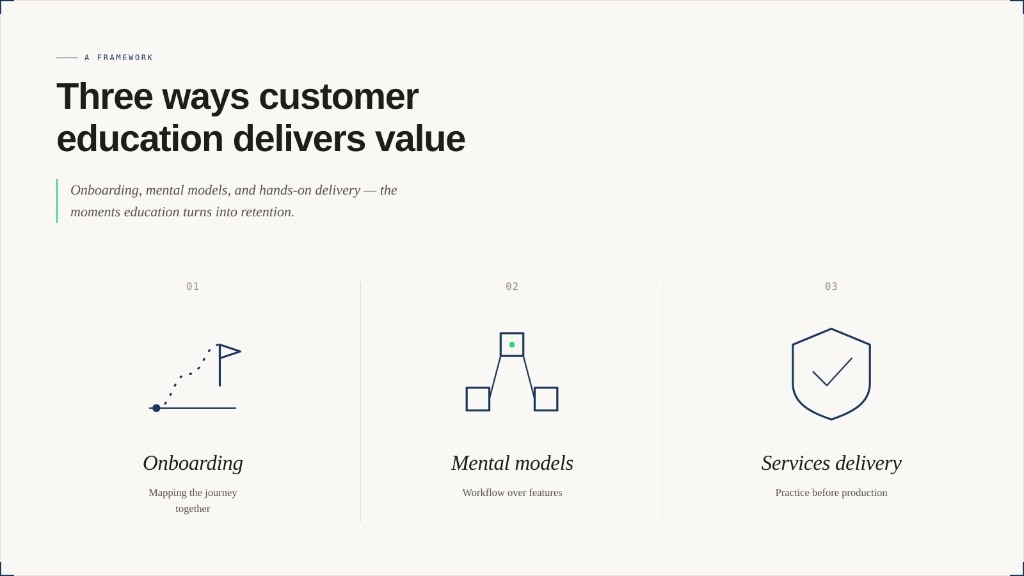
Three Ways Customer Education Delivers Value
Customer education can prove value in three lanes that go well beyond feature tutorials:
- Onboarding. Often built alongside product and UX — mapping the user journey, finding the key moments, and closing gaps with media and content the product team can't own alone. Good onboarding is a team sport between product and customer education.
- Job-to-be-done education (mental models). A more powerful lane than onboarding. Instead of teaching feature-by-feature, teach the workflow, the use case, and the way of thinking about the product inside a job.
- Services delivery. Customer education can partner with — or directly deliver — hands-on workshops, sandbox environments, and simulations, especially for high-risk processes where you want people practicing on fake data before they touch anything real.
Onboarding
One of the straightforward ways customer education can prove value is through onboarding. This is often something teams can work on together with product and UX/UI: looking at the user journey and identifying the key points where customers need to become more capable and achieve the intended results faster.
Some of those gaps can be addressed directly by the product team. Other times, there may be media assets, content, or follow-up experiences that are better suited to the customer education team. When those two groups work together, they can create a really strong experience for customers and improve onboarding success.
Customer education doesn't necessarily need to own the entire onboarding experience. There's a lot of value in having product, UX/UI, and customer education programs looking at the same journey and figuring out where each team can contribute.
Mental Models
Customer education strategies can go beyond the product itself. There is a component of a customer education strategy that is about making sure people know how to use the product, but there's a more powerful version of it that starts with the job to be done by the customer rather than the product.
Instead of teaching feature by feature, we can teach the workflow, the use case, and the mental models for how to use the product within an organization or a particular workflow. That means asking questions like:
- Where does this fit into the job to be done?
- What are the prerequisites for this to work?
- What would the outputs be if it works?
- How would you know whether these things are working or not?
- What are the considerations around technology, resources, and people?
Those ways of thinking about working with a product or a product suite are often not product-feature specific. They're about understanding how the product fits into the work and how it solves a particular challenge.
That's a very different approach from simply saying, "Here's the button that loads data, and here's the button that publishes data."
Services Delivery
Customer education also has a unique ability to deliver — or partner with people delivering — services within the organization. Education can be a means through which services are delivered through hands-on workshops, over-the-shoulder experiences, practice environments, and simulations.
If you have something that's fairly high risk, for example, you may want people to practice deploying it in a sandbox environment or running through a high-risk process using pretend data instead of client data. Customer education programs can create those environments so people have an opportunity to practice before they have to do something for real.
That makes customer education one way to achieve this kind of experience in a hybrid professional services model. It doesn't have to be limited to content or traditional training. It can also create the environments and experiences where customers actually build the capability to perform the work.
The Reframe: Content vs. Capability
Content is helpful. Capability is what lasts.
The mistake most customer education departments make when they build a strategy is thinking their job is to produce more content about product features, when the actual job is building the capability the customer needs to do their job.
Case Study: Clay Customer Education
Clay went from roughly $1M to $100M ARR in about two years. The visible layer is content — executive posts, a documented growth playbook, a series called How Clay Uses Clay that shows the company running its own GTM motion on its own product. Clay's GTM engineering writing explains the mechanism well. But the mechanism underneath is what matters for this argument:
Capability over information. Clay's lead magnets are templates, certifications, and live builds — not ebooks. An ebook transfers information and leaves the reader to do the work of turning it into a result. A template transfers capability and produces a result in minutes.
A career ladder, not a funnel. Reader becomes user becomes learner becomes creator becomes expert becomes partner. Certification gets someone a job, clients, and status — not just an email address. Some partner agencies built on this ladder have surpassed $1M in annual revenue.
Public self-use as proof. Showing the company running its own revenue operation on its own product removes the "does this work at scale" objection before it's raised.
Clay's system technically lives under marketing, not customer education. But the mechanism is the same argument this piece is making: build capability infrastructure, not just content.
Consumption vs. Application
Content consumption and product engagement are two different things, and the gap between them is the whole point. Someone can consume everything in the Academy, watch every YouTube video, and never log in and do anything with it. That's a customer who's interested in learning — great — but not applying it.
Application is where ROI lives. Product utilization means the customer is actually doing the thing the product promised to help them do. High content consumption with low product engagement usually means the content is good, but customers still aren't converting into super users.
"Engagement" or "utilization" doesn't mean the same thing across businesses, and there isn't one universal metric:
- Seats or users added to the platform
- Time spent on platform / daily active users
- Data volume moved through the system
- Usage-based signals
High content consumption combined with low product utilization can mean our content is probably really good, but our customers still aren't converting into what we would consider super users. And that's the whole point.
The specific metric for engagement or utilization is going to be different for every software business. Some companies care about daily active users or time spent on the platform. Some care about the amount of data moving through a system. Others care about API calls or usage-based signals. Some care about the number of seats or users added to the platform.
Zapier is a good example of why there isn't one universal metric. They don't necessarily care whether you log in again. They care about how many Zaps you run.
So there's something universally true about using the product more, but how "more" gets measured is different for almost every company.
The Close
None of this exists in a vacuum — the job customer education does ties directly to whatever goal the executive leading it is optimizing for this season:
- Ticket deflection requires different programming than
- Account penetration (usage frequency across enterprise seats), which is different than
- Throughput, high-risk case handling, or partner enablement (labs, sandboxes, simulated environments)
All of these reduce support load, increase utilization, build confidence, or expand what customers believe is possible with the product. That's customer education. The mistake is building one type of program regardless of which goal you're actually being measured on.
Ready to build customer education around capability, not just content? Book a strategy call to map your program to the outcomes your customers — and your executives — actually need.