

A customer finishes an onboarding course, earns a certification, and gives the training a five-star rating. By most learning platform standards, that looks like a success. But three months later, the customer is still struggling to use a core feature, support tickets are piling up, and the account has yet to achieve the outcome it purchased the product for.
So, did the education work?
The answer depends on what the education was supposed to accomplish. If the goal was to get someone through a course, the numbers look good. If the goal was to help a customer become proficient with the product, those same numbers tell a much less convincing story.
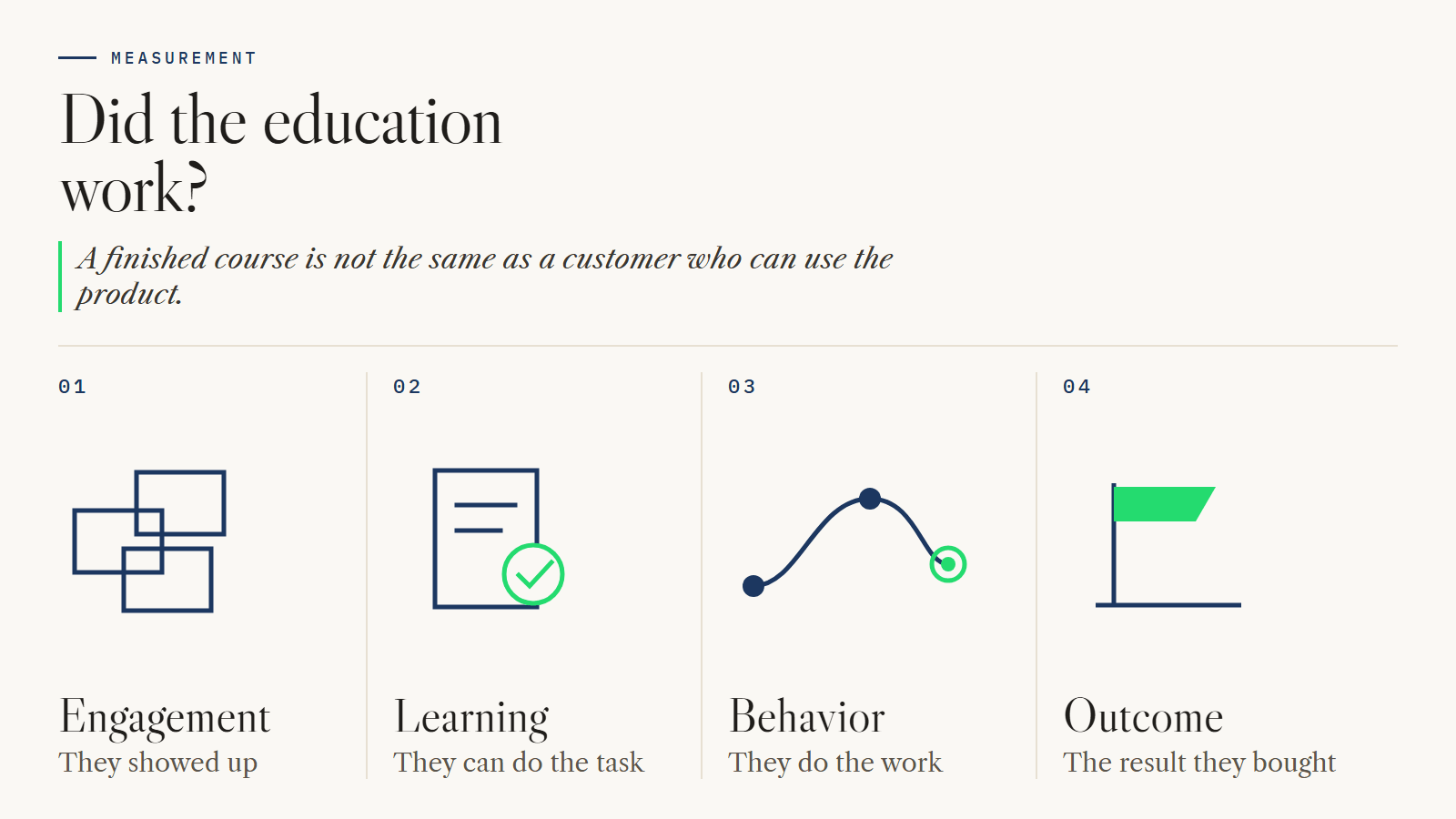
Measuring customer education effectively requires looking beyond the learning experience itself. Completion rates, attendance, and engagement can help teams understand whether customers are participating, but they cannot establish whether customers learned the material, applied it, or achieved better results. To evaluate effectiveness, education teams need to connect learning data with evidence of customer capability, product behavior, and business outcomes.
Start by Measuring What Customers Can Do
One of the most useful distinctions in education measurement is the difference between completing a learning experience and demonstrating a skill. The first is easy to track. The second requires more thought, because it starts with defining what a customer should be able to do after the training.
This is where the measurement process should begin. Before launching a course, certification, or onboarding program, identify the specific task or capability the customer needs to develop. Then determine what evidence would demonstrate that the customer has acquired it.
For example, a customer education team at a software company might build a course to help administrators configure a reporting dashboard. Course completion tells the team who reached the end of the material. A practical assessment can establish whether those administrators can configure the dashboard correctly, select the appropriate data, and produce a report without step-by-step assistance.
The same principle applies to more complex products. If customers need to complete a multi-step workflow, a short quiz may confirm that they understand the terminology without proving that they can execute the process. A guided exercise, simulation, or demonstration may provide much stronger evidence of capability.
This approach also reveals where education is falling short. If customers complete training but consistently fail a practical assessment, the team has a more specific problem to investigate. Perhaps the explanation is unclear, the exercise does not reflect real working conditions, or the training assumes knowledge customers do not have. Instead of responding by creating more content, the team can address the gap between what customers are taught and what they need to do.
Track Whether Learning Changes Product Behavior
A customer can demonstrate a skill in a training environment and still fail to apply it when returning to work. Competing priorities, confusing interfaces, internal processes, and limited opportunities to practice can all prevent knowledge from translating into action.
For that reason, the next level of measurement is behavioral change. Are customers using the product differently after education? Are they adopting the features, workflows, and practices the program was designed to support?
The right indicators depend on the product and the customer use case. A team responsible for onboarding might measure the percentage of new accounts that complete a key workflow within their first 30 days. A team educating existing customers about an advanced feature might track adoption of that feature among eligible users. A program focused on improving self-service might examine whether customers can resolve common tasks independently.
These measures are more useful when the team establishes a baseline. If feature adoption was already increasing before the educational program launched, the team needs to account for that trend rather than automatically crediting training for the improvement. Comparing behavior before and after an intervention is a good starting point, although it does not prove that education caused the change.
Where possible, teams can strengthen the analysis by comparing similar groups of customers, such as those who completed a specific learning experience and those who did not. The comparison should account for meaningful differences in account size, customer maturity, product access, and use case. Customers who voluntarily seek out training may already be more motivated or engaged than customers who do not.
The objective is to understand whether education is associated with the behavior it was intended to change, and how strong that evidence is. Product analytics, learning platform data, and customer success records can provide different pieces of the picture. When those sources are connected, teams can begin to see which learning experiences are followed by meaningful changes in how customers use the product.
Choose Business Outcomes That Match the Purpose of the Program
Product usage is an important indicator, but more usage is not automatically better. A customer can log in every day without accomplishing anything meaningful, while another can use a product occasionally and still achieve excellent results. The key is to measure behavior that contributes to the outcome the customer actually wants.
This is where education measurement moves from product adoption to business impact. For an onboarding program, a relevant outcome might be the time it takes a customer to reach their first meaningful result. For training on a complex workflow, it might be a reduction in processing time, fewer errors, or greater consistency in completing the task. For education designed to help customers work independently, it might be a reduction in support requests related to the specific process being taught.
The metric should follow the problem the education is intended to solve. If a software company creates a training program to help customers automate a manual process, measuring course completion alone misses the point. Measuring whether trained customers can complete the process faster, with fewer errors, provides a much clearer indication of whether the program is delivering its intended benefit.
It is also important to distinguish between a result that improved after training and a result that improved because of training. Customer outcomes are affected by many variables, including product changes, implementation quality, staffing, and the customer's own business conditions. Strong evaluation considers these factors rather than assuming that every improvement can be attributed to education.
Not every program needs an elaborate financial analysis. Sometimes, a reliable before-and-after comparison supported by product data and customer interviews provides enough evidence to make a useful decision. The level of rigor should reflect the importance of the investment, the availability of data, and the consequences of getting the decision wrong.
Understand How Education Relates to Retention and Expansion
For customer education leaders, one of the most important questions is whether education contributes to healthier, longer-lasting customer relationships. Customers who know how to use a product effectively may be better positioned to achieve value, adopt additional capabilities, and justify continued investment. But the relationship between education and retention needs to be examined rather than assumed.
A useful starting point is to compare retention and expansion patterns across customer groups while accounting for differences between them. For example, a company might examine whether customers who complete role-specific onboarding are more likely to adopt core workflows, reach important milestones, and renew than comparable customers who do not complete that training. It could also examine whether customers who complete advanced education are more likely to adopt additional features or expand their use of the product.
These comparisons can help identify patterns, but they need careful interpretation. Customers who participate in education may already have stronger executive sponsorship, more motivated users, or better implementation support. Those factors can also influence retention. A higher renewal rate among trained customers is a reason to investigate further, not sufficient proof that training caused the difference.
The same caution applies to expansion. A customer who adopts more product capabilities after training may be discovering genuine additional value, but the expansion could also be driven by a new business initiative or a change in organizational priorities. The education team should look for evidence that learning helped customers become capable of using those capabilities and that the resulting usage supported a meaningful customer need.
Retention and expansion are also lagging indicators. They can take months or years to observe, and waiting for renewal data is not a practical way to evaluate every course. That is why education teams should track earlier indicators, such as demonstrated capability, adoption of important workflows, and progress toward customer milestones, alongside longer-term commercial outcomes.
When these measures are viewed together, customer education can provide a more credible account of its contribution to customer success without claiming sole responsibility for results influenced by the entire customer relationship.
Use the Right Metrics for the Right Decision
A common mistake in measurement is treating every available number as equally important. A dashboard filled with course views, average watch time, satisfaction scores, quiz results, feature usage, support tickets, and renewal rates can look comprehensive while leaving the team uncertain about what to do next.
The solution is to choose metrics based on the decision the team needs to make. If the question is whether customers can find and access training, participation and completion data are appropriate. If the question is whether they learned a process, assess their knowledge or ability to perform it. If the question is whether the education changed how they work, examine the relevant product behavior. If the question is whether the investment contributes to customer or business results, evaluate the outcomes connected to the original objective.
This also means recognizing that different educational initiatives require different measures. A short feature tutorial should not necessarily be evaluated using the same criteria as a comprehensive onboarding program. A certification intended to establish technical proficiency needs evidence of competence, while a webinar designed to introduce customers to a new capability may initially be judged by whether it reaches the relevant audience and generates meaningful follow-up activity.
The team should resist the temptation to select metrics simply because they are easy to collect. Instead, identify the intended result first, determine what evidence would demonstrate progress, and then establish which data sources can provide that evidence. In many organizations, the required information already exists across the learning platform, product analytics, support system, CRM, and customer success records. The challenge is connecting the information around a shared objective.
A smaller set of relevant measures will usually be more useful than a large dashboard of disconnected activity. It also makes it easier to explain the program's performance to leadership, identify gaps, and decide where to invest next.
Make Measurement Part of the Education Program
Measurement is most useful when it is built into the design of customer education rather than added after a program has launched. By that point, the team may have plenty of engagement data but no baseline for customer behavior, no agreed definition of success, and no reliable way to evaluate the impact of the investment.
Before launching a program, document the customer problem, the capability or behavior the education is intended to change, and the business outcome that change should support. Record the current state wherever possible, choose a reasonable period for evaluating progress, and identify who will help collect and interpret the evidence.
After launch, evaluate results at different intervals. Learning assessments may provide immediate feedback, while changes in product behavior may require several weeks of observation. Retention and expansion may take much longer. Reviewing the evidence at the appropriate intervals helps teams distinguish early signs of progress from outcomes that require more time to emerge.
Just as importantly, the findings should lead to a decision. If customers understand the material but do not apply it, investigate what prevents them from using the skill. If behavior changes but the expected business outcome does not, reconsider whether the behavior is the right indicator or whether other barriers are limiting results. If a program consistently helps customers achieve the intended outcome, identify how that experience can be extended to more customers or incorporated into the standard customer journey.
The goal is not to build a perfect attribution model for every educational resource. It is to create a reliable process for learning what works, identifying what does not, and improving the program based on evidence.
The Measure of Effective Customer Education
A successful customer education program should be able to answer more than how many people completed its courses. It should be able to show what customers learned, whether they applied that knowledge, and how the resulting changes relate to the outcomes they need to achieve.
Those answers will not always be equally easy to obtain. Engagement data is readily available, while demonstrated capability requires deliberate assessment and business impact often takes longer to evaluate. That is precisely why teams need to measure across these different levels rather than relying on the numbers that are easiest to report.
When customer education is measured this way, the results become useful beyond the education team. Product teams can identify where customers struggle. Customer success teams can see which capabilities and behaviors support progress. Leadership can make better-informed decisions about where education deserves further investment.
Ultimately, the value of customer education is not established by the amount of content delivered or the number of customers who complete it. It is established by evidence that customers are becoming more capable, using the product more effectively, and making progress toward the outcomes that matter to them and the business.
Ready to measure whether customer education is actually working? Book a strategy call to connect capability, behavior, and the outcomes your customers bought.