
Customer education teams rarely fail because they cannot create good content. Most teams know how to write, record, edit, organize, and publish. They can build documentation, tutorials, webinars, academies, certifications, and other educational resources.
The problem is that all of that activity can still leave customers without a clear path to the outcomes they bought the product to achieve.
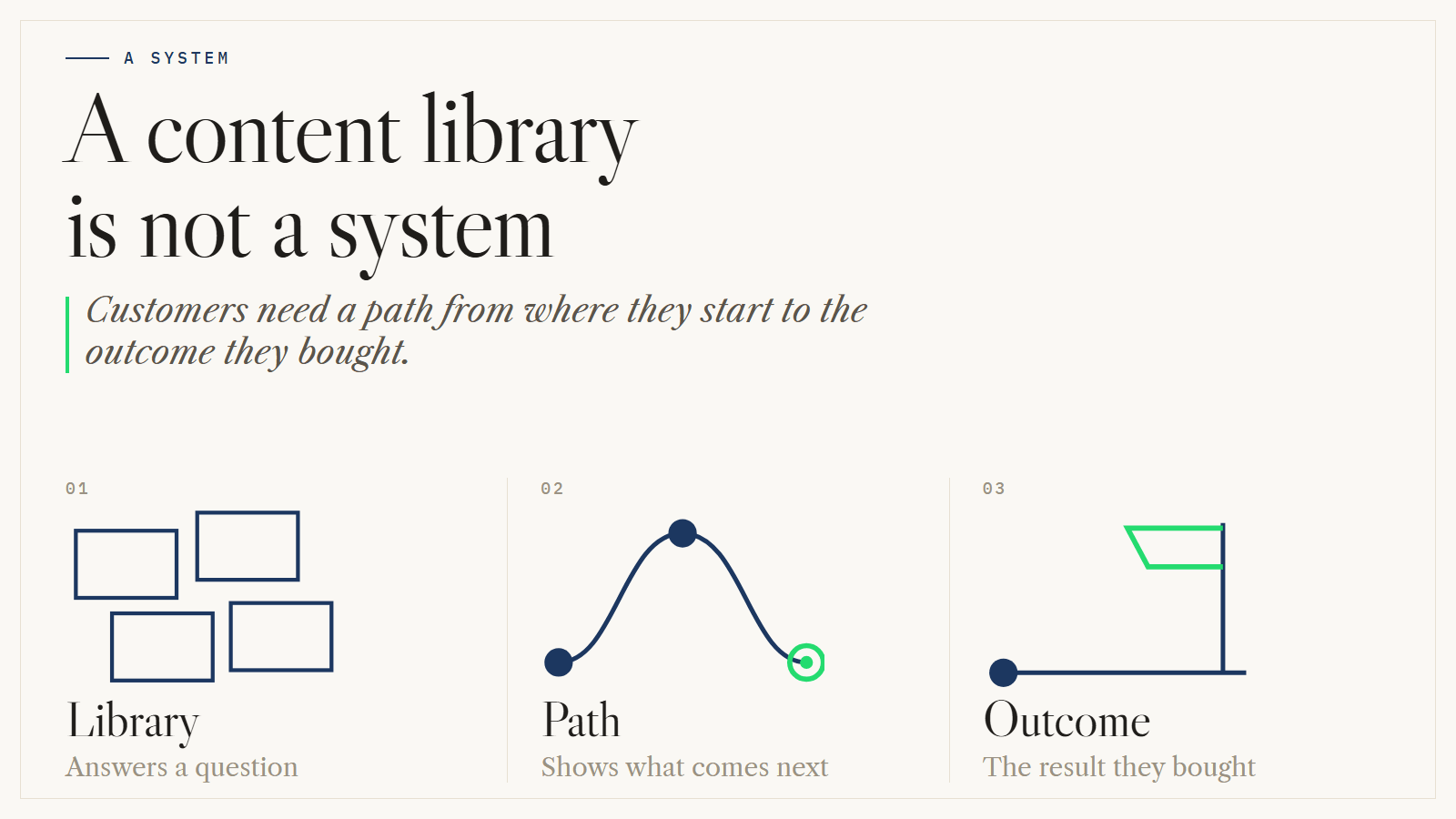
That is the difference between creating educational content and building a customer education system. A library can be useful, but a system is what makes the result repeatable.
A Content Library Is Not a Customer Education System
Think about a typical product education library. It might contain hundreds of videos, help articles, tutorials, webinars, and other resources organized around the product. If a customer searches for "How do I do X?" and finds a three-minute video that answers the question, the library has done its job.
But that is different from helping the customer achieve a larger outcome.
A customer education system starts with a known point and ends with a known result. It defines the steps, decisions, and experiences required to get someone from one to the other. Some of those steps may involve educational content. Others may involve practice, configuration, collaboration, or actually using the product. The content is one part of the system, rather than the system itself.
Consider a painter. Being an excellent painter is one capability; running a successful painting business is another. The second requires a process for understanding what the customer wants, selecting the right materials, discussing options and pricing, completing the work, and delivering the finished result. The craft matters, but the system is what makes the outcome repeatable.
HubSpot provides a useful example of what this looks like in software. As the company expanded the capabilities of its platform, its education wasn't limited to explaining how new features worked. It also taught customers how to use those capabilities to accomplish things like generating leads, building pipeline, creating content, and running their businesses. Certifications and education around marketing best practices existed because having the product infrastructure was only useful if customers knew how to turn it into business results.
That is a fundamentally different approach to customer education. Instead of treating education as a collection of resources that sits alongside the product, it becomes part of the path customers follow to achieve the outcomes the product was designed to support.
Why Customer Education Becomes a Content Factory
One of the biggest problems is structural. Customer education teams often contain people who are extremely good at teaching and creating content, but they can be surprisingly far removed from the day-to-day reality of the customer.
An account manager may hear why a customer bought. A customer success manager may understand what the customer is trying to accomplish and where they are struggling. Product teams may see feature requests and usage patterns. Sales teams understand why deals are won or lost. Customer education teams do not always have the same exposure.
There may be no formal process for teaching a new education team member about the market, the competitive landscape, the problems customers are trying to solve, the reasons prospects choose competitors, or the decision-making frameworks customers use. That context often has to be accumulated over years of experience, if it arrives at all.
Without that context, the product itself becomes the easiest source of direction. A new screen ships, so someone asks for a new video. A feature changes, so the documentation gets updated. Another release arrives, and the cycle starts again.
This is how a customer education team can gradually become a content factory tied to the product release calendar. The team stays busy, but the work becomes increasingly disconnected from the larger customer journey.
None of that means feature-level education is unnecessary. It is an important baseline. Customers need to understand how the product works, and they need access to just-in-time help when they get stuck. The problem comes when that baseline becomes the entire education strategy.
Helping someone understand a feature is not the same as helping them use the product to accomplish something meaningful. The latter often requires more consultative customer education: labs, workflow practice, problem-solving exercises, guided paths, and experiences that reflect the way customers actually work.
A Complete Academy Can Still Leave Customers Lost
We have seen this problem show up in academy audits.
In one case, a client had recently purchased a product and wanted to get trained. Their question was straightforward: they had the product, they wanted to get up to speed, and they wanted to know where they should start.
The academy appeared comprehensive. There were videos covering practically every feature and function. From a content-production perspective, it looked like a strong education program.
But there was no clear experience for the customer to follow.
There wasn't a designed path that said: start here, complete this, then move to this, and once you've done that, you're ready for the next stage. Customers without a dedicated customer success manager to guide them through implementation were effectively left to navigate the library themselves.
Eventually, that created a support problem. The customer submitted a ticket asking what they were actually supposed to do next.
This is an important distinction for customer education teams. The issue wasn't a lack of content. It was a lack of direction.
A large content library can answer hundreds of individual questions and still fail to help a customer understand what they should do next. When customer education is designed around a sequence of outcomes rather than a collection of topics, the experience becomes much more useful to both the customer and the customer success organization.
Customer Education Should Follow the Customer's Workflow
This is where customer education strategy needs to move beyond the product itself.
Customers don't experience your product as a list of features. They have a job to do, a workflow to complete, decisions to make, constraints to work within, and a definition of what success looks like.
Your education program should understand that journey.
If the goal is to help a customer achieve a particular business outcome, the education experience should identify the sequence of actions that gets them there. That may include product education, but it may also include practice, templates, examples, decision points, live sessions, or other experiences that have little to do with explaining a button.
This changes the question the education team is asking. Instead of starting with "What content do we need to create?", the better starting point is "What does the customer need to be able to do?"
That shift also changes how customer education and customer success can work together. Customer success teams are often closer to the customer's goals and challenges, while education teams are responsible for creating scalable ways for customers to develop the knowledge and capability they need. When those functions are connected, education can extend the work of customer success rather than simply becoming another destination customers are expected to find on their own.
It also creates a more meaningful way to think about measurement. Content consumption can tell you whether someone watched a video or opened an article, but it doesn't necessarily tell you whether they became capable of doing the thing the education was supposed to enable.
The closer education gets to a defined customer outcome, the easier it becomes to evaluate whether the program is actually helping customers succeed.
The Missing Context Is a Leadership Problem
It is tempting to say that customer education teams simply need to learn more about their customers. That is only partly true.
A content creator shouldn't have to independently reconstruct the entire market, competitive landscape, customer journey, and business strategy through years of trial and error. Leadership has a responsibility to create and distribute that context.
Teams need a shared understanding of the problems the company solves, the challenges customers face, why customers choose the product, where competitors win, and what the company does differently. That information cannot simply live inside a CRM field or inside the heads of a few customer-facing employees. It has to be actively socialized across the organization.
This matters because customer education sits within a much larger customer journey. The education team needs to understand where its work fits, what customers are trying to accomplish, and why particular capabilities matter. Without that context, it is difficult to determine which educational experiences deserve investment and which are simply keeping pace with product releases.
And that baseline cannot remain static. Markets shift, products evolve, sales motions change, and customer expectations move. The context that made sense six months ago may no longer be the context teams should be building from today.
The goal is not to create one giant document that explains the market and consider the job finished. The goal is to keep the organization connected to what customers are actually trying to accomplish and to continuously update that shared understanding.
Build Customer Education Around the Use Cases That Matter Most
The other missing piece is a deliberate library of customer use cases.
Not feature lists. Actual examples of how customers use the product, what works, what doesn't, where they get stuck, and what outcomes they are trying to achieve.
This becomes particularly valuable when connected to customer value. If certain use cases consistently appear among customers with higher lifetime value or longer retention, those use cases should influence what the education program prioritizes.
That does not mean ignoring everything else. A baseline of product coverage still matters. It means recognizing that not every feature, workflow, or educational experience deserves equal strategic weight.
If you know which use cases matter most to your highest-value customers, you can start asking better questions about your customer education program. Which capabilities support those use cases? Where do customers struggle? What needs to be practiced rather than simply explained? Where does customer success repeatedly have to step in and provide guidance that could eventually be made more scalable?
Those questions produce a very different education roadmap than simply looking at the next product release.
The result is an education program built around how customers create value, rather than around everything the product happens to be capable of doing.
From Content Production to Customer Outcomes
Customer education programs don't miss the mark because their teams don't care. They miss because being busy and being effective are not the same thing.
A release calendar will always create enough work to keep a team occupied. There will always be another feature to document, another video to update, and another article to publish. That work can be necessary while still leaving the bigger question unanswered: can the customer actually get where they are trying to go?
A strong customer education program is more than a large collection of resources. It connects customer context, use cases, learning experiences, product usage, and desired outcomes into a system that helps customers move forward.
The content still matters. The craft still matters. But content is one component of the system, not the system itself.
For customer success teams, that distinction matters because scalable education should help customers develop the capability to succeed without requiring every customer to receive the same level of one-to-one guidance. For customer education teams, it provides a clearer standard for deciding what to build and why.
The goal isn't to produce more education.
It is to build education that helps customers accomplish more with the product.
Ready to turn a content library into a customer education system? Book a strategy call to map the path from where customers start to the outcome they bought.