

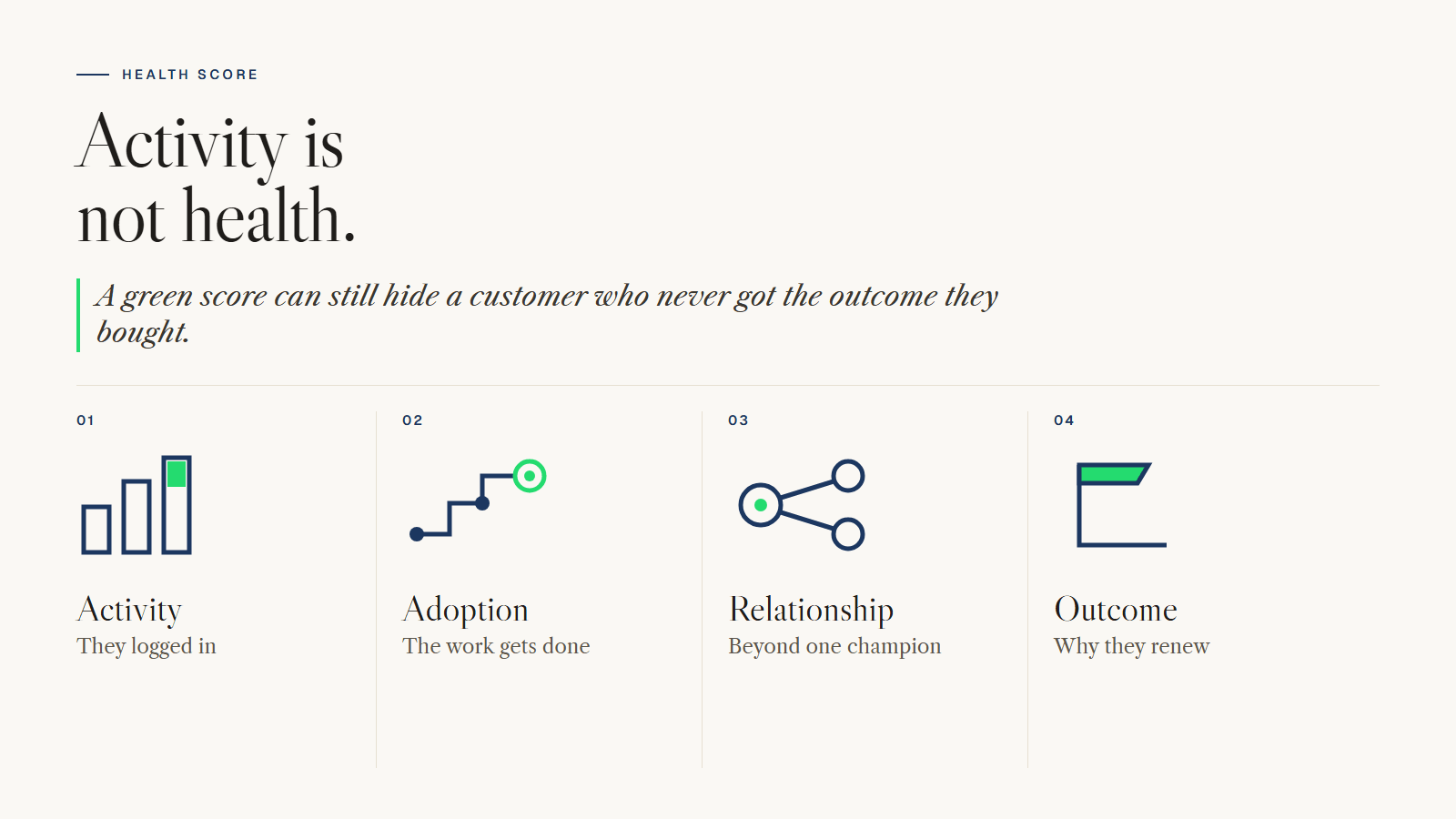
Your customer health score says an account is green. Your CSM feels good about the relationship. Product usage looks consistent. Then the customer announces they're leaving. The problem may not be your scoring model. It may be what you're measuring in the first place.
Every Customer Success leader has experienced some version of this situation.
An account has a healthy score. The customer logs in regularly, attends scheduled meetings, responds to emails, and hasn't raised any major support issues. Nothing in the dashboard suggests a problem.
Then the renewal conversation happens, and the customer decides not to continue.
The immediate question is usually whether the health score failed. If it couldn't identify an account at risk of churning, what purpose was it serving?
But the problem may be more fundamental than the scoring formula itself.
A customer health score is only as useful as the information behind it. If the inputs measure activity rather than customer success, the score can look reassuring while the actual relationship is deteriorating.
The purpose of a health score isn't simply to tell you whether a customer is interacting with your product. It's to help you understand how confident you should be that the customer is achieving the outcomes they expected when they bought it.
And those are two very different things.
Customer education runs into the same gap. What customer education can actually prove is not a completion rate or a satisfaction score. Those numbers show that someone finished the material. They do not, by themselves, show that the account achieved the outcome it bought. A health score has to clear that same bar.
Activity Is Not the Same as Customer Health
One of the easiest ways to build a health score is to use the metrics that are readily available.
Logins, session duration, feature usage, email engagement, webinar attendance, meeting participation. These numbers are relatively easy to collect, and they give Customer Success teams something objective to track.
The problem begins when those metrics become the primary definition of a healthy customer.
Consider an account where the primary contact logs in every day, regularly attends meetings, and frequently interacts with the platform. On paper, this looks like a strong relationship.
But a closer examination reveals that only one person actively uses the product. The account has adopted a single feature, never implemented the workflow that originally justified the purchase, and hasn't involved its executive sponsor in a business review for months.
The account is active, but is it getting value?
Now consider another customer who logs in only a couple of times per month. That might look like disengagement until you understand how the product fits into their business. Perhaps they run a particular process twice a month, and the platform performs exactly as expected every time. Multiple administrators are trained, the workflow is established, and the customer has renewed several times.
The second account may be considerably healthier despite having lower activity.
This is why usage metrics need context. The frequency of interaction doesn't tell you whether the customer is accomplishing what they bought the product to accomplish.
Healthy usage looks different depending on the product, the customer's industry, and the business problem being solved.
A health score should reflect those differences instead of assuming that more activity always means more value.
Product Usage Can Create a False Sense of Security
Product adoption is an important part of customer health, but measuring it primarily through frequency or volume can create blind spots.
Many health models reward customers for logging in frequently, using multiple features, or increasing their overall activity. Those indicators can be useful, but they don't necessarily demonstrate meaningful adoption.
The more important question is whether customers are using the capabilities that support their intended business outcomes.
Are they completing the workflows they purchased the product to improve? Have they adopted the functionality that enables them to realize the expected return on investment? Is adoption expanding across the organization, or is the product still dependent on a small group of users?
Imagine a company that purchases a platform to automate an important business process. Six months later, its employees are logging in every day, and the product dashboard shows consistent activity.
But the automation was never fully implemented. Employees are still performing the original process manually, using the platform as another place to manage information rather than as the solution that was supposed to improve their operations.
The product is being used, but the customer isn't necessarily getting the value they expected.
This distinction becomes especially important when an account has one particularly engaged user.
Almost every organization has a champion who knows the product inside and out. They attend every meeting, explore new features, share feedback, and communicate regularly with the Customer Success team.
That person can make an account look exceptionally healthy.
But what happens when the champion leaves?
If nobody else understands the product, if adoption hasn't expanded to other teams, and if the organization hasn't incorporated the solution into its broader workflows, the account may be far more vulnerable than its usage data suggests.
A strong health model needs to look beyond individual engagement and evaluate the depth of adoption across the organization.
The objective isn't to count how often someone uses the product. It's to understand whether the product has become part of how the customer operates.
The Missing Dimension: Relationship Health
Product data can tell you a lot about how customers interact with your solution. It cannot tell you everything about the relationship that supports the renewal.
Software doesn't renew itself. People make those decisions.
Yet many health scores give relatively little attention to the people involved in the customer relationship. They track product usage, support activity, and engagement metrics while overlooking changes in the relationships that influence purchasing decisions.
Think about an account where product usage remains consistent, support volume is low, and the primary contact has always been responsive.
Then that contact stops replying.
A few weeks later, they leave the organization. Their replacement wasn't involved in the original buying decision and doesn't fully understand why the company invested in the product.
Nothing has changed in the platform. The usage data still looks healthy. But the commercial relationship is suddenly much more vulnerable.
This is why relationship health deserves a place in the conversation.
Customer Success teams should understand whether their relationships extend beyond a single champion, whether executive sponsors remain engaged, and whether the people responsible for the original business objectives are still involved.
Some useful signals include executive participation in business reviews, responsiveness from key stakeholders, the strength of relationships across different departments, and the willingness of customers to share honest feedback.
That last point deserves particular attention.
Not all negative feedback is a sign of a deteriorating relationship. A customer who challenges your team, identifies problems, and pushes for improvements may be deeply invested in the success of the product.
The context matters. A customer who has stopped communicating is different from one who actively tells you what isn't working.
The important thing is that these signals should prompt investigation rather than being interpreted automatically as positive or negative.
Relationship health can deteriorate long before product usage changes. If your health score only looks at the product, you may discover the problem when it's already too late.
A Health Score Should Reflect the Customer's Definition of Success
These three problems have something in common: they measure what is easy to observe instead of what is important to understand.
Logins are easy to count. Feature usage is easy to track. Meetings and email responses are easy to record.
But customer success requires more context.
A customer might be highly active without achieving meaningful outcomes. Another might use only a small portion of the product but depend on it for an important business process. A third might demonstrate excellent adoption while quietly losing the executive support needed to renew.
A useful health model needs to account for all three dimensions.
First, understand the outcomes the customer expected to achieve. What business problem were they trying to solve? Which workflows or capabilities are essential to delivering that result? Without this context, it's difficult to distinguish meaningful product adoption from activity that simply looks impressive in a dashboard.
Second, evaluate whether adoption is translating into actual value. Look beyond frequency and examine whether customers are completing important workflows, expanding usage across relevant teams, and making progress toward their original objectives.
Finally, understand the relationships supporting that value. Are the right people involved? Does the executive sponsor still recognize the investment? Can the customer articulate why the product matters to their organization?
These dimensions don't need to be reduced to a single universal formula. Different products, customer segments, and business models will require different indicators.
The important thing is that the score reflects the conditions that make an account successful, not simply the data your systems happen to collect.
Stop Asking Whether the Account Is Active. Start Asking Whether It's Successful.
A health score should help Customer Success teams anticipate problems, prioritize their attention, and understand where intervention is needed.
But it can only do that when it reflects the actual conditions behind customer retention.
If an account is green because one person logs in every day, that score may be telling you more about individual activity than organizational adoption.
If an account is green because support tickets are low, you may be overlooking a customer that has stopped investing in the relationship.
And if an account is green because product usage hasn't declined, you may miss the fact that its executive sponsor has left and nobody else understands the original business case.
The answer isn't necessarily to add more metrics or make the scoring model more complicated.
It's to reconsider what those metrics are supposed to tell you.
Customer health is ultimately about the customer's ability to achieve meaningful outcomes with your product, sustain that value across the organization, and recognize why the relationship is worth continuing.
A dashboard can help you see the signals. But the signals only become useful when you understand what they mean.
If one of your green accounts announced tomorrow that it was churning, would your health score help you understand why?
If not, the place to start isn't the color of the score. It's the definition of customer health behind it.
Ready to measure health by outcomes, not activity? Book a strategy call to separate a green score from an account that will actually renew.