

Imagine that explainer videos disappeared tomorrow. What would customer education still be responsible for?
The answer should be the same as it was before AI: building customers' capability to solve business problems with the tools the company sells.
If an explainer video is the most effective way to develop a particular capability, let AI help produce it. If a tooltip provides the right guidance at the right moment, use that. If customers need a personalized walkthrough, peer mentoring, office hours, an intensive training session, or a formal certification path, the team should be responsible for determining that need and designing the appropriate intervention.
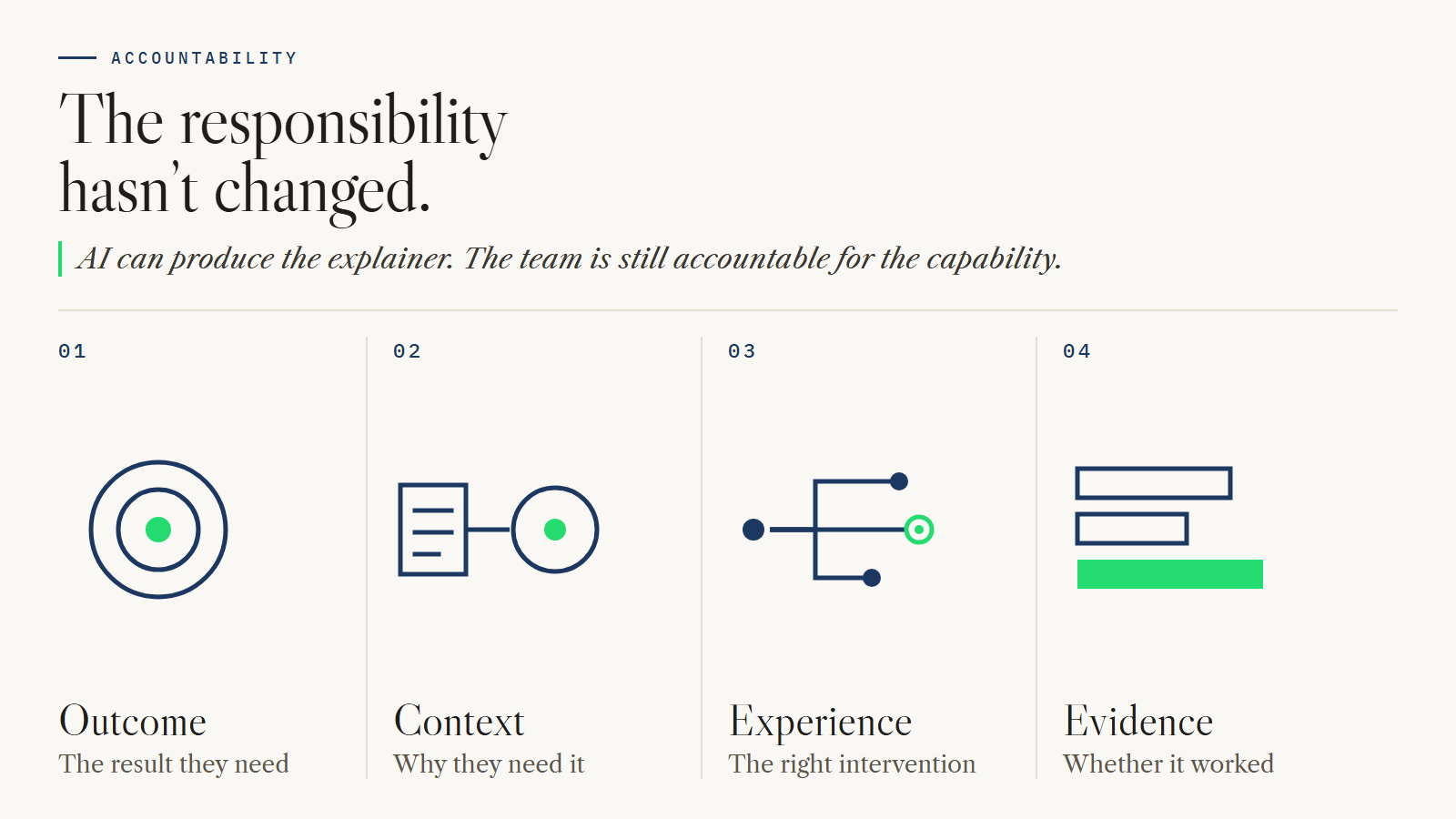
The work includes defining the capability, understanding the customer and their use case, selecting the right experience, testing the approach, and measuring whether it produces the intended result.
It also means looking beyond the learning experience itself. If customers complete training but cannot apply what they learned, the team needs to understand why. If an AI-guided workflow helps customers complete a task independently, the team should be able to evaluate that result. If a more structured experience produces better outcomes, that evidence should inform how the program develops.
AI becomes a tool for delivering these experiences more efficiently, accurately, or safely. The responsibility for deciding what needs to happen and evaluating whether it worked remains with the team.
This changes where customer education professionals should spend their time. Less effort may be required to draft routine explanations or manually update every piece of documentation. More effort can go toward understanding customer workflows, designing product experiences, improving live instruction, developing qualification paths, and building business cases for education initiatives that create measurable value.
It also opens the door to new models for delivering and monetizing customer education. When teams understand which capabilities customers need and can demonstrate the value of developing them, they are better positioned to design education services that extend beyond a library of resources.
Start With the Customer's Desired Outcome
If customer education is accountable for building capability, the first question is not what content to create. It's what the customer needs to be able to accomplish.
That distinction matters because product knowledge and customer capability are not the same thing. A customer might understand every step in a workflow but still struggle to apply it to their own business. They might know which features exist without understanding which ones are relevant to their role or how those features fit into a larger process.
The starting point should be the business problem the customer is trying to solve. What are they trying to accomplish? What do they need to know or do to accomplish it? Where are they getting stuck today? And what would demonstrate that they can now do it successfully?
Those questions give customer education a clearer basis for deciding what to teach and how to deliver it. They also help separate genuine capability gaps from problems that education cannot solve on its own. If a workflow is unnecessarily complicated, a product improvement may be more effective than another training module. If customers lack the access or internal support required to use a feature, better documentation will not resolve the underlying barrier.
AI can help teams deliver guidance once the need is understood. But identifying the need requires an understanding of the customer, their environment, and the outcome they're working toward.
Give AI the Context It Needs to Be Useful
AI-generated guidance is only as useful as the information and context behind it.
A product repository might explain how a feature works, while a documentation portal describes how to use it. Neither necessarily explains why a particular customer needs the feature, how it connects to their existing workflow, or which business outcome it is supposed to support.
That context needs to be captured and maintained deliberately.
Customer education teams can help connect product knowledge to customer use cases, common workflows, role-specific requirements, and the problems customers are trying to solve. They can also help establish how product changes affect existing learning experiences, rather than treating every release as an isolated documentation task.
This becomes increasingly important as AI takes on more of the work involved in answering questions and delivering personalized guidance. An agent that knows the product's features can explain them. An agent with access to reliable customer context has a better chance of explaining which features matter in a given situation and what the customer should do next.
That does not mean customer education must own every source of information across the organization. Product teams still need to maintain accurate technical information, and customer-facing teams contribute important knowledge about customer needs and behavior. The opportunity is to ensure those sources connect, so AI tools can draw on a more complete picture of how the product delivers value.
Without that connection, organizations risk automating the production of information while leaving the customer to figure out what it means.
Design the Experience, Not Just the Content
Once the desired capability is clear, the next decision is how to help customers develop it.
This is where customer education can move beyond choosing between a video, a course, or a written guide. Different capabilities require different learning experiences, and the right approach depends on the complexity of the task, the customer's existing knowledge, the consequences of making a mistake, and the point at which guidance is needed.
A customer who needs to understand a single setting might benefit from a contextual tooltip. Someone configuring a complex workflow for the first time may need a guided walkthrough and an opportunity to practice. A team rolling out a new process across an organization might need structured instruction, supporting materials, and a way to verify that everyone can perform the task correctly.
AI creates more flexibility in how those experiences can be delivered. It can help personalize explanations, respond to questions as they arise, and provide guidance within the product itself. But greater flexibility also increases the importance of deciding which experience is appropriate.
An instant answer may help a customer move past a small obstacle. It may not be enough to develop proficiency in a complicated process. Likewise, a formal course may be effective for building foundational knowledge but unnecessarily slow for an experienced user who needs help with one specific task.
Customer education teams should evaluate these choices against the capability they are trying to develop. The objective is not to make every experience more personalized or to introduce AI wherever possible. It is to reduce the distance between what customers need to accomplish and their ability to accomplish it.
Measure Capability, Not Just Participation
If the responsibility of customer education is to develop customer capability, then measuring participation alone is insufficient.
Course completions, attendance, content views, and satisfaction scores can tell teams whether customers are engaging with an educational experience. They cannot establish whether customers can apply what they learned or whether that application is helping them achieve the intended outcome.
Measurement needs to follow the objective. If a program is designed to help administrators configure a product correctly, the team should look for evidence that they can complete that task. If the objective is to increase adoption of an important workflow, the team should evaluate whether customers are actually using it. If education is intended to accelerate time to value, the team should examine whether customers are reaching meaningful milestones more quickly.
AI can support this work by making it easier to deliver assessments, provide feedback, and identify patterns in customer questions or learning behavior. Those signals can help teams identify where customers struggle and which parts of an experience may need improvement.
However, the presence of more data does not automatically establish impact. Teams still need to define what success means, choose relevant measures, and consider other factors that influence customer outcomes. A customer who completes an AI-guided tutorial and adopts a feature may be making progress, but the team should still evaluate whether that adoption supports the business result the customer needs.
The purpose of measurement is to understand whether the educational intervention worked and what should happen next. When evidence shows that customers are struggling, the response might be to improve the learning experience, address a product usability issue, or work with customer success to remove another barrier.
That makes measurement part of the design process, not simply a report produced after the content has been published.
Turn Customer Education Into a Strategic Capability
When teams spend less time producing routine content, they have an opportunity to focus on work that is harder to automate and more closely connected to business results.
They can investigate why customers struggle with particular workflows, collaborate with product teams to improve the experience, develop practice environments for complex tasks, and create qualification paths that help customers demonstrate proficiency. They can also work with customer success to identify which capabilities are most important at different stages of the customer journey.
This work can strengthen the connection between customer education and retention. Customers who develop the ability to achieve meaningful outcomes with a product are better positioned to realize its value. That does not mean education alone determines whether an account renews, but it does mean that the capabilities education develops can contribute to a healthier customer relationship.
There may also be opportunities to build new education services around those capabilities. When a company understands the skills customers need, it can develop advanced training, role-based certification, intensive workshops, or other programs that support more complex customer needs. Where those services deliver clear value, they may also create opportunities for monetization.
These opportunities require more than automating existing content production. They require customer education teams to understand their customers, establish which capabilities matter, and demonstrate the value of developing them.
AI can make delivery more efficient and expand what teams can offer. The strategic opportunity lies in using those capabilities to solve problems that matter to customers and the business.
The Responsibility Hasn't Changed. The Opportunity Has.
AI will continue to change how customer education teams create content, maintain documentation, and deliver guidance. Explanations that once required hours of work may soon be generated automatically, and customers will increasingly expect relevant answers at the moment they need them.
That makes content production less of a differentiator. It does not make customer education less important.
The central responsibility remains building customers' capability to solve business problems with the products a company sells. The work is to understand what customers need to accomplish, determine which experiences will help them develop the necessary skills, and evaluate whether those experiences produce meaningful results.
When AI can handle more of the production work, customer education professionals can redirect their attention toward those decisions. They can spend more time on customer context, learning experience design, practical qualification, product improvement, and demonstrating the value of education.
The question is no longer simply how to produce the information customers need. It's how to help them use that information to become capable, independent, and successful with the product.
That is what customer education should be accountable for, regardless of which tools it uses to get there.
Ready to hold customer education accountable for capability? Book a strategy call to define the outcome, choose the experience, and decide how you will know it worked.