

AI can explain product features, answer customer questions, and generate documentation in seconds. It can personalize guidance, respond to a user in the middle of a workflow, and make information available exactly when someone needs it.
For customer education teams, the question is no longer how to produce and deliver information. It's how to turn that information into customer capability.
If a customer can ask an AI agent how to use a feature and receive an immediate answer, how much value is there in producing another explainer video? If documentation can be generated automatically from product updates, should education teams still spend their time writing and maintaining it?
These are reasonable questions, but they start from the wrong assumption: that producing educational content is the job.
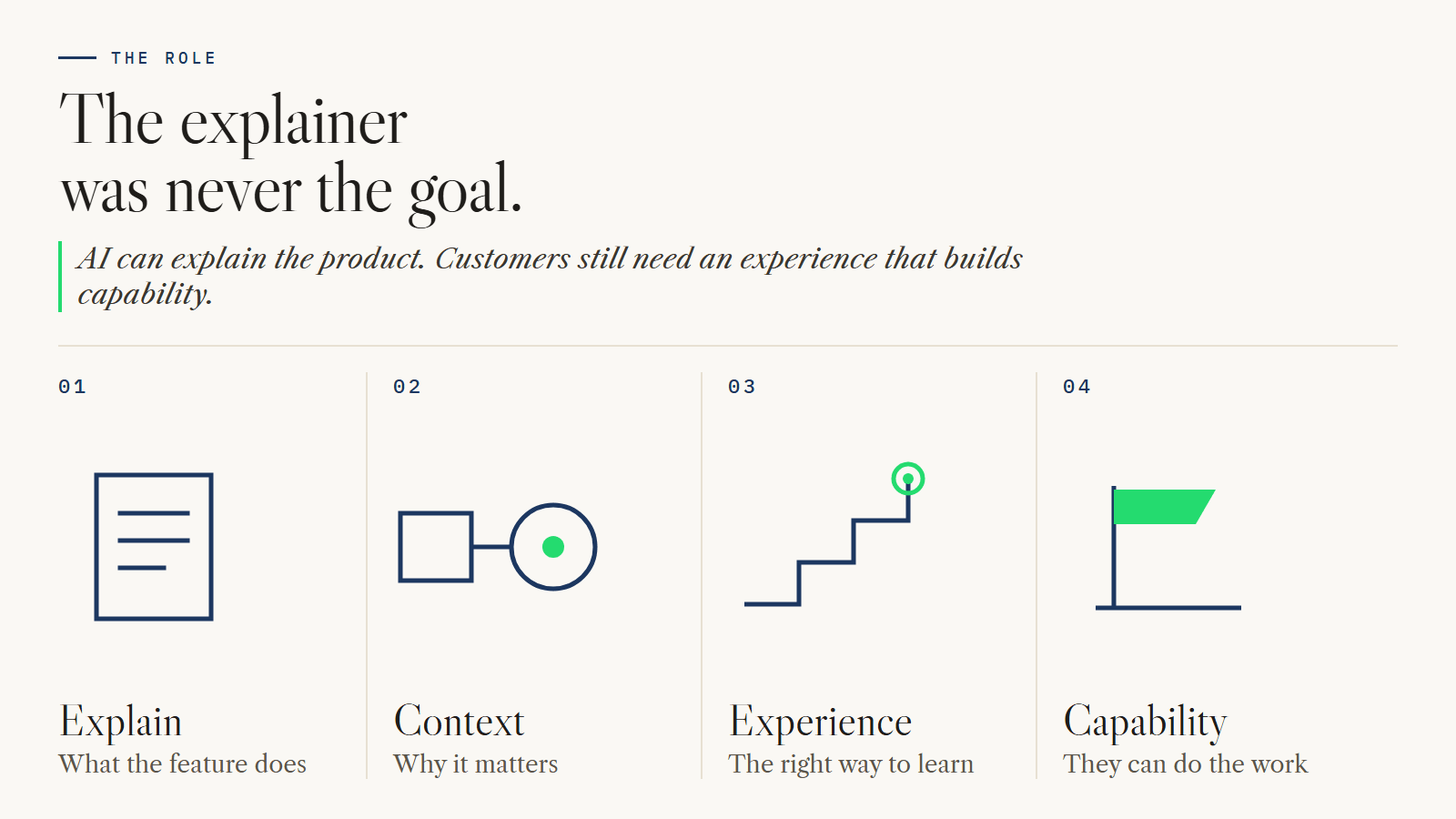
Customer education is responsible for building customers' capability to solve business problems with the products a company sells. Content is one way to develop that capability, but it has never been the outcome itself. As AI makes information easier and cheaper to produce, the more important work is deciding what customers need to learn, when they need it, and which experience will help them apply it.
AI Can Explain the Product. It Still Needs to Understand the Customer.
AI is particularly effective at answering questions such as "How do I do this?" or explaining what a feature does. It can turn technical information into instructions, generate documentation, and provide just-in-time guidance without requiring a customer to search through a knowledge base.
There is one important condition: the information behind those answers needs to be accurate, current, and grounded in the right context.
For many organizations, the code repository is the source of truth for how the product works. But knowing what changed in the code is not the same as understanding what that change means for a customer.
Translating a product update into useful, client-ready guidance can still require significant work, even when AI handles the initial draft.
For example, let's consider the release of a new feature that changes how a user configures a workflow.
The code can tell an AI agent which functionality was added. It may be able to generate a clear explanation of the new setting, how to access it, and what it does. What it may not know is why a particular customer uses that workflow, which business problem the workflow supports, or how the change affects the outcome the customer is trying to achieve.
That context matters. A feature does not exist in isolation from the work customers are trying to accomplish.
Customer education teams are well positioned to maintain this connection between the product and its real-world use. They understand the customer use cases, workflows, and capabilities the product is supposed to support. They can help establish what a new feature means for those use cases and which customers need to understand the change.
This also raises an important question of ownership. Product teams, documentation teams, and customer education teams may all contribute to the information customers receive, but someone needs to ensure that the underlying knowledge reflects both how the product works and how customers actually use it.
AI can make that knowledge easier to access and distribute. It cannot compensate for context that the organization has never captured.
What Happens When You Automate Documentation?
We tested this idea by creating a Markdown brand voice guide that included customer personas and types, then setting up a GitHub workflow to draft documentation whenever a pull request came in.
The result could explain what had changed in the product and communicate it in the right tone based on the brand guide markdown files and style guides. For example, it could describe a newly added button using the established voice and style.
But that was not especially valuable on its own.
We could have achieved a similar result with much less setup simply by looking at the product interface and describing the change in a voice note. The generated draft also required substantial preparation before it was ready to use.
The experiment did not demonstrate that AI-generated documentation is ineffective. It demonstrated that automating the production of an explanation is not necessarily the same as eliminating the work required to make that explanation useful.
The workflow becomes much more valuable when it can draw on a broader context library: previous feature updates, existing documentation, established use cases, and the history of how the product has evolved. With the ability to retrieve that information and update related materials, an AI agent could potentially do more than describe a change. It could help maintain the larger body of knowledge customers depend on.
That is a promising direction, although it remains a hypothesis rather than a result I've established through testing.
The broader lesson is that the value of AI depends partly on the quality of the knowledge it can access. A tool that understands the code and the brand voice can produce a well-written explanation. A tool that also understands the customer, the workflow, and the intended outcome has the potential to produce something much more useful.
Customer education can help supply that missing context and bring it into the systems that generate and deliver customer-facing guidance.
The Scarcer Resource Is No Longer Information. It's a Useful Learning Experience.
When information becomes inexpensive to produce, the competitive advantage shifts toward knowing how to organize and deliver it.
A customer rarely needs every piece of information about a product at once. They need the right knowledge at the point where it helps them make progress. Sometimes that means a quick answer in the middle of a task. Other times, it means a structured learning path that builds the skills required to complete a more complex workflow.
The difference is not simply the format of the content. It is the design of the experience around it.
Customer education teams need to determine which knowledge a customer needs first, what they must understand before moving forward, and how each step contributes to a meaningful outcome. They also need to decide whether the best delivery method is a short explanation, personalized guidance, a formal course, a practice environment, or direct instruction.
AI makes it possible to distribute information in more ways and personalize it to the situation. That creates more opportunities for customer education. It also makes the judgment behind those decisions more important. Having more ways to deliver information does not automatically mean customers will learn faster or become more capable.
The question is whether the experience helps someone do their job better.
For example, an AI agent might explain how to configure a complex feature while a customer is working through the setup. That may be enough for an experienced user who needs a reminder. A new administrator working through the same process for the first time may need a guided exercise, an opportunity to practice, and confirmation that they can complete the task correctly.
The information might be similar. The intervention should not necessarily be.
This is where customer education moves beyond content production and into the design of customer capability.
Why Practice and Human Instruction Still Matter
Access to information and confidence in applying it are two different things.
An AI agent can explain a process, answer follow-up questions, and walk someone through a sequence of actions. But a customer may still be uncertain about whether they can perform that process reliably in their actual working environment, particularly when the task carries operational or business consequences.
Practice environments, simulations, instructor-led sessions, and formal qualification paths can help bridge that gap. They provide opportunities to apply knowledge, make mistakes, receive feedback, and demonstrate competence. In some cases, another person is also the most appropriate source of evaluation and confirmation that someone is ready to perform the task.
This does not mean every customer needs a live training session or that human instruction should remain the default. Some capabilities can be developed effectively through personalized, AI-supported guidance. Others require structured practice or human assessment.
The responsibility of customer education is to determine which approach fits the capability being developed, test whether it works, and evaluate the results.
That decision should not be driven by which format the team has historically produced or which format is easiest to automate. It should be driven by what customers need to become capable of doing.
The Future Is Not About Producing More Content
AI will continue to change how customer education teams create, maintain, and deliver information. Some tasks that once required hours of work will become increasingly inexpensive, while personalized and just-in-time guidance will become easier to provide at scale.
That is an opportunity, not a reason for customer education to lose its purpose.
The explainer video was never the goal. Neither was the course, the documentation portal, or the number of resources in the library. Those were methods for helping customers develop the capabilities they need to succeed with a product.
As AI makes those methods easier to produce, customer education teams have an opportunity to focus more deliberately on the work behind them: understanding the customer, connecting product functionality to real-world use cases, sequencing knowledge toward an outcome, and designing experiences that help people apply what they learn.
The organizations that get this right will not simply use AI to produce more educational content. They will use it to make customer education more relevant, timely, and effective.
Because when information is readily available, the real value is knowing what customers need to do with it — and helping them become capable of doing it.
Ready to build customer capability, not just more content? Book a strategy call to decide what customers need to learn and which experience will help them apply it.