

"Customer education drives retention" is an easy statement to make. Proving it is considerably harder.
Most education teams can tell you how many people completed a course, attended a live session, earned a certification, or gave positive feedback in a survey. Those are useful metrics. They demonstrate that people are engaging with the education program and that the team is delivering what it set out to deliver.
But they don't necessarily tell you whether those people are using the product more effectively, whether their accounts are getting more value, or whether the education program contributed to a renewal.
That's where the conversation gets more interesting.
In our article, Customer Education as Revenue Infrastructure, we explored why education deserves a more strategic role in the business. The next question is how teams can demonstrate that value with the data they actually have.
The answer isn't necessarily to build a sophisticated analytics infrastructure from day one. It's to understand what you can credibly measure, recognize where the gaps are, and develop a path toward stronger evidence.
Two Types of Customer Education Programs, Two Different Scorecards
In my experience, education programs tend to operate in two distinct lanes: those that charge for training and certifications, and those that provide education as part of the broader customer experience.
The difference matters because their business models create different measurement priorities.
Commercialized education programs operate much like other revenue-generating functions. They need to make their training and certifications known, equip potential buyers to make a purchasing decision, convert those buyers into customers, and then measure the performance of the program. Their reporting often includes total revenue, revenue per participant, certification sales, and comparisons across different programs.
Non-commercialized education programs typically report on enrollment, course completions, attendance, certifications issued, and learner satisfaction. These metrics help demonstrate participation and program delivery, but they don't automatically establish a connection to product adoption or account performance.
There is some overlap between the two. In fact, the strongest opportunity may exist at their intersection: a commercial training and certification program that also develops specific capabilities with the product.
When that happens, the team can move beyond measuring how many people purchased or completed training and start asking a more important question: What are those people doing with the product afterward?
Are they using more of its capabilities? Are they creating things, running projects, or adding users? Are they progressing through the activation steps that matter for their particular use case?
That's where customer education starts to connect its own performance to the performance of the customer.
The Measurement Problem: Connecting the Learner to the Customer Account
Most education teams already have access to meaningful data about their programs. They can report how many people attended a live session, completed a course, earned a certification, or responded to a survey.
The challenge is connecting those measurements to what happens outside the academy.
A learner has an identity in the learning management system. That person may have a different user ID in the product, a contact record in Salesforce or HubSpot, and another identity associated with a webinar, email campaign, or other customer interaction. Product analytics tools such as Mixpanel, PostHog, or Pendo may capture behavioral data, but that information is often stored separately from the learner's education history.
Each system has its own ecosystem. The CRM has its contacts and account records. The product has its users and activity data. The academy has its learners, courses, and certifications. Product analytics has its own events and behavioral information.
To build a complete picture, someone has to connect those pieces.
Ideally, a team could identify a learner, understand which training they completed, connect that person to their product activity, and then see how that activity contributes to the broader account's health and renewal behavior.
But that requires consistent identifiers, cooperation across departments, and often a data infrastructure capable of bringing information from multiple systems together.
Without a data lake or meaningful investment from the teams responsible for those systems, this can become an extremely difficult project. Many education teams simply don't have the resources or organizational support to make it happen. Eventually, they abandon the effort and return to anecdotal evidence: a customer story, a positive comment, or an account that renewed after completing training.
Those stories can be valuable, but they aren't a substitute for measurement.
The question is whether you need to solve the entire integration problem before you can start building a credible case. In most situations, you don't.
Start With the Data You Can Actually Access
There are ways to begin measuring the relationship between education and customer outcomes without connecting every individual user across every system.
Two approaches worth exploring are customer cohorts and account-level training density.
1. Compare Customer Cohorts
Not every customer starts their journey from the same place. A company adopting your product for the first time has different needs from one that already uses another product in your portfolio. A customer switching from a direct competitor may have entirely different expectations and levels of familiarity.
These differences are useful when evaluating education.
You can group customers into cohorts based on how they entered the organization or adopted the product:
- New customers: Organizations using your solution for the first time.
- Cross-sell customers: Existing customers adding another product to their relationship with you.
- Competitive conversions: Organizations moving from a competing platform to your product.
Once those groups are established, look at the activation steps that matter for each one. Are customers creating projects? Are they adding users? Are they completing important workflows? Are they participating in training?
Then compare those behaviors across the cohorts.
The objective is to understand whether education participation is associated with differences in activation and product behavior. For example, do customers who complete a particular training program reach important activation milestones more consistently than customers who don't?
You may not be able to attribute those differences entirely to education, but you can begin identifying patterns that deserve further investigation.
2. Measure Account-Level Training Density
Another approach is to look at how many people within an account have registered for or completed training and compare that figure with the account's renewal and expansion behavior.
Think of this as training density: the proportion of a customer's relevant population that has participated in education.
If you can establish a historical trend showing that accounts with higher training density also tend to renew at higher rates, you have a useful signal to investigate.
The challenge is understanding the denominator.
Imagine selling to a Fortune 500 organization. Only a fraction of its employees may ever interact with your product. Comparing the number of trained users against the company's total employee population would tell you very little about actual education coverage.
You need a reasonable estimate of the people who could realistically use the solution.
Some industries make this easier than others. Depending on the product and customer, you may be able to identify the total number of people performing a particular role or function within an organization. That gives you a more meaningful population against which to measure training participation.
Once you have that denominator, you can begin comparing account density with renewal outcomes and tracking whether the relationship holds over time.
Neither approach requires perfect user-level integration. Both give teams a starting point for understanding whether education participation and customer behavior are moving together.
What a Commercialized Training Program Can Teach Us
I've seen a commercialized training program demonstrate the value of this approach particularly well.
Because the program charged for training, we could associate the number of users trained with individual organizations. More importantly, much of the market information needed to estimate the potential audience at each organization was publicly available.
That gave us two useful pieces of information: how many people within an organization had been trained and how many potential participants remained.
With that visibility, we could build a clearer picture of the market and forecast future training revenue against the total addressable opportunity. We could also estimate what would need to happen to bring additional organizations and partners into the program.
But the measurement didn't stop at training revenue.
We also had a clear picture of renewal and expansion behavior across those organizations. That allowed us to compare training activity with the commercial performance of the accounts. Over time, teams began sharing customer stories and case studies on their own, providing additional context around the value customers were getting.
Interestingly, we didn't have particularly strong utilization data. The product operated on standalone desktop devices, which made measuring usage difficult.
We didn't need that information to establish the relationship we were investigating. We had visibility into training behavior and renewal behavior, and that was enough to build a useful picture of how the program was performing.
There are two important lessons here.
First, having a knowable denominator makes a significant difference. Understanding how many people could participate gives you a much stronger basis for measuring education penetration and forecasting future opportunity.
Second, a clear renewal signal can be valuable even when product utilization isn't available.
This example showed a strong association between training participation and renewal behavior. It supported forecasting and gave the business a more credible way to understand the commercial opportunity.
It did not, by itself, prove that training caused those organizations to renew. Other factors may have contributed to the outcome, and that distinction matters.
For cloud-based products, the opportunity to go further may be greater. If teams can successfully map academy identities to product user IDs and connect those records to product analytics, they may be able to examine how training relates to actual product usage as well.
That's a more complete picture, but it doesn't have to be the starting point.
Build the Proof in Stages
The biggest mistake teams can make is treating measurement as an all-or-nothing project.
They either try to build a fully integrated picture of every customer interaction, discover how difficult it is, and abandon the effort, or they settle for reporting completions and satisfaction scores without ever trying to connect education to business performance.
There is a more practical path.
Start with what your team can already demonstrate. Report participation, course completion, certifications, and learner feedback. These are legitimate measures of education delivery, and they establish a baseline.
Then look for opportunities to connect that information to account-level behavior. Compare customer cohorts, examine training density, and look at renewal and expansion trends. Be clear about what those comparisons suggest and what they don't establish.
If you begin to see a meaningful relationship between education and customer outcomes, you have a stronger reason to invest in connecting the underlying systems. You can make a more informed case for the data integration, technical resources, and cross-functional support needed to move toward user-level measurement.
The goal isn't to make every metric prove more than it can. It's to improve the quality of the evidence over time.
Customer Education Needs More Than a Good Story
Customer education teams shouldn't have to rely entirely on anecdotes to explain their contribution to the business. But they also shouldn't claim that every certification, completed course, or training session directly produces retention.
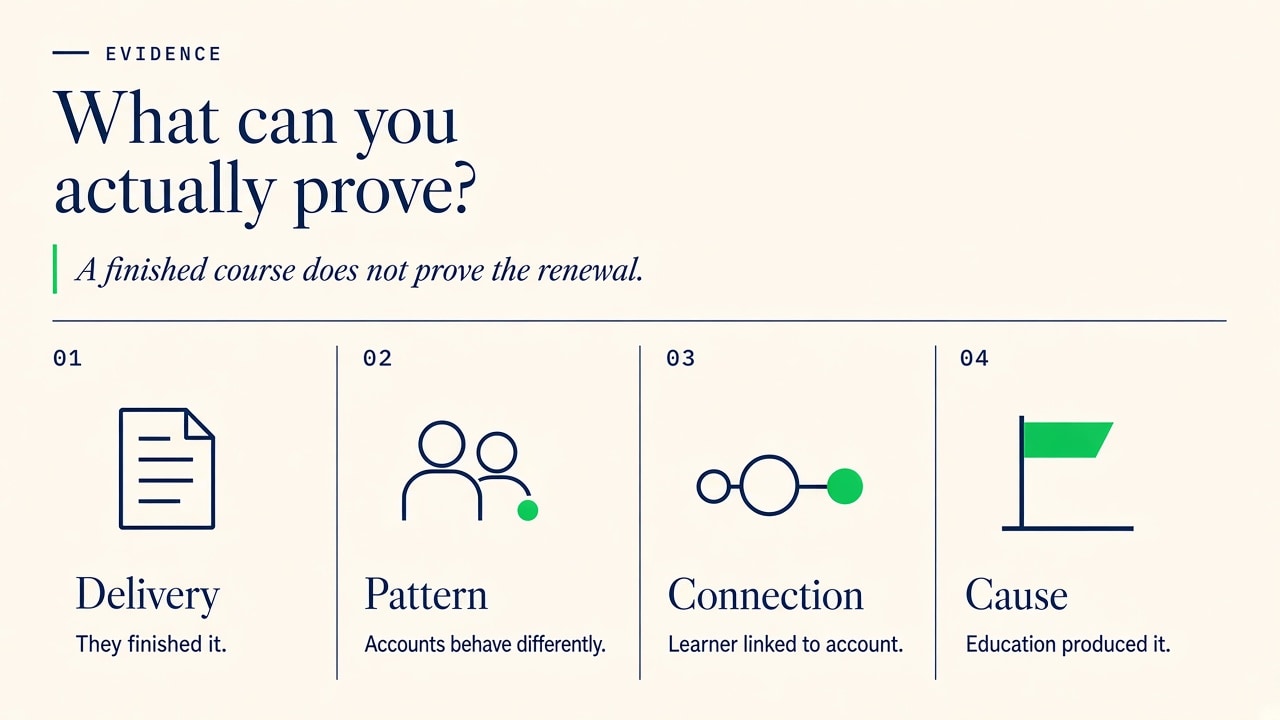
There is a meaningful difference between demonstrating that education happened, showing that trained customers behave differently, and proving that education caused a particular business outcome.
Teams need to understand those distinctions and report accordingly.
The path toward demonstrating revenue impact doesn't necessarily begin with a sophisticated data infrastructure. It begins with knowing what you can measure today, identifying the gaps, and building a case for closing them based on the signals you find.
In our view, customer education deserves to be treated as revenue infrastructure. But that position becomes much stronger when teams can show how their work connects to customer behavior, account performance, and commercial outcomes.
You don't need perfect data to start making that case.
You do need to be honest about what the data actually proves.
Ready to find out what customer education can actually prove? Book a strategy call to separate what you can measure today from what the data does not yet prove.