
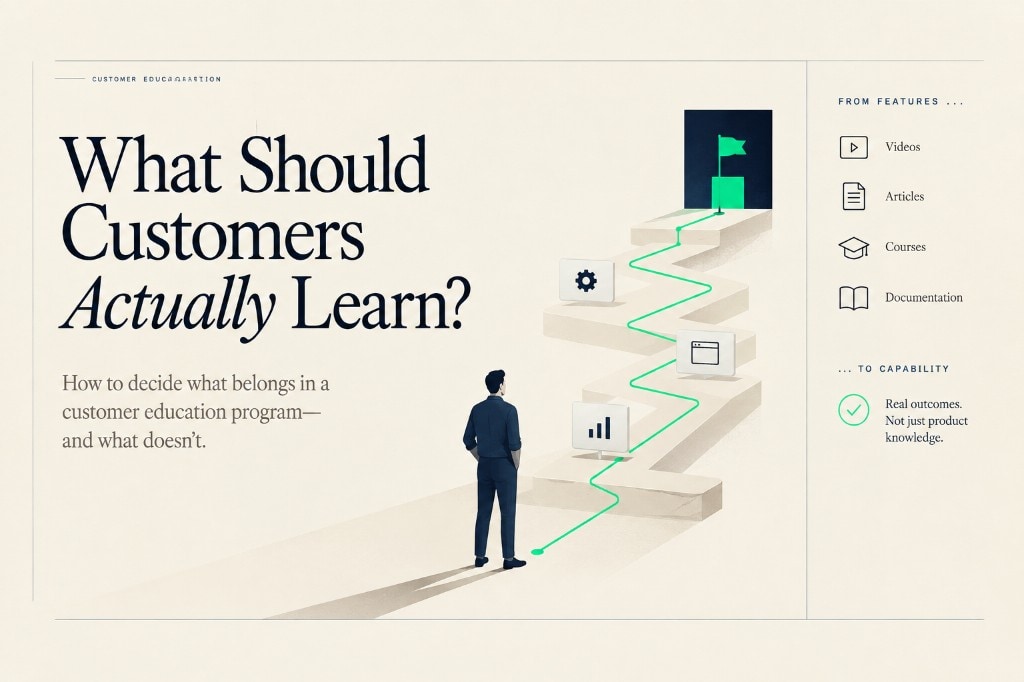
Most customer education programs start in the same place: the product.
A new feature launches, so someone creates a video. A customer asks how something works, so the team writes an article. A product manager wants better adoption of a feature, so another training module gets added to the library. Over time, the organization ends up with a substantial collection of educational content.
The problem is that having more content doesn't necessarily mean customers are more capable.
The better starting point for a customer education content strategy is not the product. It's the customer. What are they actually trying to accomplish? What does their workflow look like? Where do they get stuck? And, most importantly, what do they need to be capable of doing to get the outcome they bought the product for?
That shift sounds simple, but it changes what you build, how you organize it, and what you measure.
The Feature-First Mistake
The feature-first approach is understandable. When you're close to the product, it's easy to think about education in terms of everything customers need to know about it. You have a list of features, settings, workflows, and functionality, so you turn those into videos, articles, courses, and documentation.
The problem is that customers don't experience your product as a list of features. They experience it as part of a job they're trying to get done.
A customer might need to review a document, configure a workflow, run a report, or complete a specific process. To accomplish that, they may have to use five different features in sequence. Knowing how each individual feature works doesn't necessarily tell them how those features fit together or when to use one versus another.
That's where a lot of customer education programs fall short. They successfully explain the product, but they don't necessarily teach customers how to use the product to accomplish something meaningful.
This is also why I think it's useful to separate product knowledge from customer capability. Product knowledge is knowing what a feature does. Capability is being able to use the product effectively in the context of a real task.
Customer education should be designed around the second one.
What Belongs in a Customer Education Program?
This doesn't mean that feature-level education has no place. It does. The problem is treating every piece of product information as though it serves the same educational purpose.
A useful customer education program helps customers build the knowledge, skills, and mental models they need to complete the workflows that matter to them. That might include understanding how a particular feature works, but only as part of a larger context.
For example, if a customer needs to complete a particular workflow, the education might explain what they are trying to accomplish, which parts of the product they need to use, how those pieces connect, and what decisions they need to make along the way. It might then give them an opportunity to practice the workflow themselves.
That is very different from simply giving them a collection of feature tutorials.
The distinction matters because the goal isn't to make customers experts in your product for its own sake. The goal is to make them capable of using the product to achieve the outcomes they care about.
Technical Resources vs. Educational Assets
There is an important distinction between technical documentation and educational content, and I don't think companies benefit from pretending they're the same thing.
Technical documentation has a very important job. It can explain how a feature works, provide a reference when someone is stuck, answer a specific question at the moment of need, support an API integration, or give an AI system the information it needs to help a customer. Those resources are valuable, and companies absolutely need them.
But calling all of that "customer education" makes the category so broad that it stops being useful.
As a rough heuristic, I think somewhere around 60–80% of what customers need is likely to be workflow-level information, while perhaps 20% is genuinely technical or feature-specific. Those numbers aren't a rule, and they will vary considerably depending on the product. The point is that most customers are not simply trying to understand how a feature works. They're trying to accomplish something, and the education needs to help them connect the pieces required to do it.
This is particularly important for complex products. The more configurable the product, the easier it is to create a huge library of technically accurate content that still leaves customers wondering how everything fits together.
How to Decide What to Teach
The best way I've found to figure this out is to watch customers actually use the product.
Live onboarding sessions are particularly useful because you get to see where customers naturally slow down, what questions they ask, and which parts of the workflow require explanation. You hear the moments where someone says, "Wait, what about this?" or asks why they would use one option instead of another. Those moments are extremely valuable when you're trying to understand what customers actually need to learn.
Obviously, you can't scale this kind of observation indefinitely. But you don't need to. The purpose isn't to sit in on every customer interaction forever. It's to use those interactions as a source of discovery.
Record and transcribe the sessions, then look for recurring patterns. If the same question comes up repeatedly, that's a signal. If customers consistently struggle at the same point in a workflow, that's a signal. If they understand individual features but can't connect them together, that's a signal that the education needs to move up a level.
The amount of discovery you need will depend on the complexity of the product. A relatively simple product may only have a handful of important workflows. A highly configurable enterprise platform may have dozens. In those environments, understanding the workflows becomes even more important because there are so many possible ways a customer could interact with the product.
A Real Example: Turning Features Into Workflows
We saw this firsthand with an enterprise e-discovery platform that already had an extensive technical education library. They had thousands of feature videos, so the problem wasn't a lack of content.
The problem was that customers couldn't always connect the features to the workflows they were responsible for completing.
Instead of simply creating more feature videos, we reorganized the library around customer workflows. We also introduced hands-on labs and activities so customers could practice those workflows in a sandbox environment and demonstrate that they could actually complete them.
That changed the experience. Instead of asking customers to understand a collection of individual features and figure out the connections themselves, the education showed them how the pieces worked together in the context of the work they were trying to accomplish.
The result was a roughly 50% increase in customer confidence.
For me, that's the distinction in a nutshell. Technical documentation answers a question like, "How does this feature work?" Customer education should also answer the much more important question: "How do I accomplish this task?"
Who Should Own Customer Education?
There isn't one universal answer to who should own customer education, and I think that's important to acknowledge.
In an early-stage company, you might have a technical founder creating resources because they're trying to reduce the number of support questions coming their way. As the company grows, marketing might start producing educational content because they're using expertise to generate demand. Later, customer success, enablement, professional services, or a dedicated education team may become involved.
None of those models is inherently right or wrong.
The better question is: what business problem are you trying to solve?
If the goal is reducing support volume, the education strategy will look different than if the goal is increasing account penetration. If you're trying to improve onboarding, you'll build something different than if you're trying to enable partners or increase utilization of an advanced feature.
The business outcome should influence what education you build and, in many cases, who is best positioned to own it.
Start With Workflows, Not Content
One of the biggest mistakes I see is starting with the question, "What content do we need to create?"
That's already too far downstream.
Before deciding whether you need a course, video, guide, lab, webinar, or knowledge base article, you need to understand the workflows your customers are trying to complete. Those workflows are the building blocks of the customer journey.
Once you map them, you can start to see where customers need education, where they need product changes, where documentation is enough, and where another part of the organization needs to step in.
You can also begin to choreograph the customer experience rather than simply reacting to questions as they come up. If you know what customers are trying to accomplish at each stage, you can anticipate what they will need next and introduce the right information at the right point in the workflow.
That's ultimately what makes a customer education program more useful. You're no longer building a library and hoping customers find something relevant. You're designing an experience around the work customers actually need to do.
What Should Customers Actually Learn?
The question isn't really, "What do customers need to know about our product?"
That's the question that leads you toward feature lists, documentation, and increasingly large content libraries.
A better question is: What are our customers trying to accomplish, and what do they need to be capable of doing to get there?
Once you start there, the decisions about what to teach become much easier. You can distinguish technical resources from education, identify the workflows that matter most, observe where customers struggle, and build the right learning experiences around those moments.
Customer education isn't about teaching customers everything there is to know about your product.
It's about giving them the capability to use it well.
Ready to build customer education around workflows, not feature lists? Book a strategy call to map what your customers actually need to be capable of doing.