
Customer Education and Customer Enablement are often used interchangeably. The overlap is understandable: both are designed to help customers succeed, both can include training and educational content, and both often work closely with Customer Success, Product, and Services.
But they solve different problems.
Customer Education builds the knowledge and capabilities customers need to use a product effectively. Customer Enablement takes those capabilities and helps customers apply them to the work they are actually trying to accomplish.
That distinction becomes important when a company is deciding what its customers need to learn, what experiences it needs to build, and how to determine whether those experiences are actually creating value.
Customer Education Builds Capability
Customer Education is about helping customers develop the knowledge and skills required to succeed with a product. That can include onboarding programs, courses, workshops, videos, documentation, assessments, and hands-on learning experiences.
The format matters less than the purpose. A strong education program is not simply a library of information about the product. It is designed around what customers need to understand and be capable of doing.
This distinction is especially important as products become more complex. A platform can have hundreds of features and still leave customers struggling to understand how those features fit together. Adding another feature video may explain how something works without helping the customer understand when to use it, how it connects to other capabilities, or how it fits into the workflow they are responsible for.
The goal of Customer Education is therefore not product knowledge for its own sake. It is customer capability.
That starts with understanding the customer rather than starting with the product. What are they trying to accomplish? What do they need to understand to get there? Which skills do they need to develop? Where are they likely to encounter friction?
Those questions should shape the education experience.
Customer Enablement Applies That Capability to the Work
Customer Enablement takes the next step by helping customers apply what they have learned to their actual work.
Consider a customer who needs to create a report. An educational resource might show them where to find the reporting feature, which fields to select, how to configure the report, and how to run it. The customer can now use the feature.
Enablement goes further. Why does the customer need the report? What decision are they trying to make? Which information matters to their role? What should happen after the report is generated? How does reporting fit into the broader workflow they are responsible for?
Those questions shift the focus from knowing how a feature works to using that capability effectively.
This is where the distinction between education and enablement becomes useful. Education can give a customer the knowledge and skills required to perform a task. Enablement connects those capabilities to the customer's role, workflow, and desired outcome.
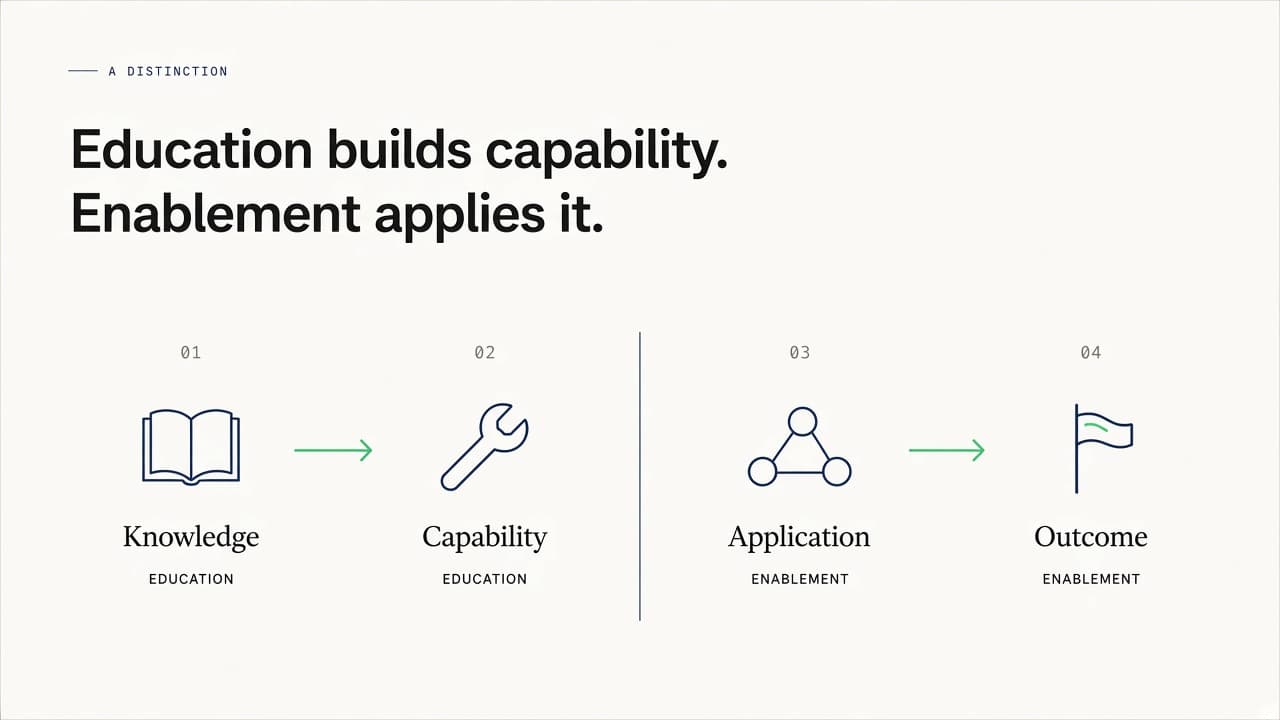
A useful way to think about the progression is:
Knowledge → Capability → Application → Outcome
Education plays a critical role in moving customers from knowledge to capability. Enablement helps them move from capability to application.
That does not necessarily mean creating more training. In some cases, the right enablement experience may be role-specific guidance, a workflow walkthrough, hands-on practice, in-product support, or an experience that helps a customer apply what they already know at the moment they need it.
The question changes from "Did the customer learn this?" to "Can the customer use it effectively in the context of their work?"
Where Customer Education and Enablement Overlap
The distinction between the two functions does not mean they operate separately. In practice, there is considerable overlap.
A video can be part of a Customer Education program or an Enablement experience. The same is true of a course, workshop, assessment, onboarding program, or piece of documentation. The format alone does not determine which function it serves.
Consider a walkthrough that teaches a customer how to configure a feature. As a standalone resource, it may simply be education: the customer learns how the feature works and how to use it.
Now place that same walkthrough inside a larger experience designed for a specific role and workflow. The customer learns why the configuration matters, practices it in a realistic environment, applies it to a specific task, and receives guidance as they work through it. The underlying content may be similar, but its purpose has changed.
The important question is not what the content is called. It is what the experience is designed to help the customer accomplish.
This also explains why there is no single organizational model for Customer Education and Customer Enablement. In one company, education may sit within Customer Success. In another, it may be part of a dedicated Education or Enablement function. Product, Services, Support, and Marketing may also own different parts of the customer learning experience.
The organizational structure matters less than whether the customer has a clear path from learning to application.
What Happens When Education and Enablement Get Confused?
The problem with confusing Customer Education and Customer Enablement is not terminology. It is what that confusion can produce.
When education becomes synonymous with producing more content, programs can start optimizing for content consumption instead of customer capability. Teams measure videos produced, course enrollments, lesson completions, training attendance, or content engagement because those metrics are easy to track.
Those numbers can be useful, but they do not necessarily show whether customers can apply what they have learned.
A company can have thousands of training resources and still have customers who struggle with adoption. Customers may understand individual features but remain unsure how those features fit into the workflows they need to complete. They may finish a course but lack the confidence to perform the work independently.
This is the difference between consumption and application.
Watching a video does not necessarily mean a customer can perform the task. Completing a course does not necessarily mean their behavior has changed. Understanding how a feature works does not necessarily mean they know when or why to use it.
That is why education and enablement need to work together. Education can build the knowledge and capability required for success, while enablement helps turn that capability into action.
The most useful measurement therefore moves beyond whether customers consumed the learning experience. It asks whether they can perform the task, use the capability in their workflow, and ultimately achieve the outcome they were trying to achieve in the first place.
Build Around the Customer Outcome
The distinction between Customer Education and Customer Enablement is useful, but it should not become another organizational exercise where teams spend more time defining functions than solving customer problems.
The better starting point is the customer outcome.
What are customers trying to accomplish? What do they need to know to get there? What do they need to be capable of doing? Where will they need guidance when they try to apply those capabilities? And what evidence would show that they have successfully reached the desired outcome?
Those questions determine what the education and enablement experience should look like.
Sometimes the answer will be a course or structured onboarding program. Sometimes it will be a workflow-based learning experience, a hands-on lab, better documentation, role-specific guidance, or support delivered at the moment of need. In some cases, the problem may not be educational at all. The product experience itself may need to change.
The important thing is to avoid treating learning as the destination.
Customer Education helps customers develop the capability to use a product effectively. Customer Enablement helps them apply that capability to the work that matters to them.
When the two are designed around the same customer outcome, education becomes more than content and enablement becomes more than another layer of training. Together, they create a clearer path from learning to action—and from action to value.
Ready to design education and enablement around the same customer outcome? Book a strategy call to map the path from learning to application.