
Customer Education is often treated as a destination.
A customer has a question, so they go to support. They need training, so someone sends them a link. They want to learn more about a feature, so they search for the right course or tutorial.
That model can work. But it creates a problem when education becomes something customers have to go looking for.
Product documentation is usually treated differently. It gets incorporated into the product, surfaced when someone needs help, and connected to the workflow the customer is already in. Product education, on the other hand, is often moved into a separate Academy and left there.
Customer Education teams can be excellent at building training and still miss the bigger question: where does education actually belong in the customer's journey with the company?
That journey starts before someone becomes a customer and continues long after onboarding. Education can help a prospect understand a problem, help a new customer get started, help an existing customer adopt more of the product, and help an experienced customer realize more value from what they've already purchased.
The challenge isn't simply creating good educational content. It's deciding who that education is for and what it needs to accomplish at that point in the journey.
The Academy Can Become an Island
One of the most common patterns is a division between Marketing and Customer Education.
Marketing owns the forward-facing website. Customer Education owns the Academy. Both teams are doing their jobs, but there isn't necessarily much coordination between the two.
The website explains the company's value proposition. The Academy explains how to use the product. Somewhere in between, there might be a link in the footer under "Resources."
Then the customer is expected to figure out the rest.
This becomes especially noticeable when an organization launches an Academy and puts significant effort into building it, but doesn't give it the same attention as the rest of the customer-facing experience. The Academy may live on a separate subdomain, have its own navigation and terminology, and be largely disconnected from the product and the main website.
That doesn't necessarily mean the content is bad. It means the education experience has become an island.
The irony is that product documentation is often much better integrated. If a customer needs to understand a field, a setting, or a particular feature, documentation can appear directly in the product or through a help experience that's already part of the workflow.
Product education rarely gets the same treatment.
Once education is placed into an Academy, someone has to intentionally connect that Academy back to the rest of the customer experience. If nobody does, it becomes something that exists rather than something customers actually encounter.
That makes discoverability a fundamental part of Customer Education.
Decide Who You're Actually Educating
There are two different ways this problem tends to show up, and they're almost mirror images of each other.
The first is overreach. A company launches a new Academy, gets excited about what it has built, and wants to put it in front of everyone. Prospects can use it. Customers can use it. Anyone interested in the company can use it.
That sounds reasonable until you look at the curriculum.
The education that helps an existing customer adopt a product is usually very different from the education that helps someone who has never used the product become interested in the problem the company solves. A prospect probably doesn't need a detailed course on configuring a feature they haven't purchased yet. They may need broader education about the problem, the workflow, or the category itself.
This is very similar to the way Marketing thinks about top-, middle-, and bottom-of-funnel content.
At the top of the funnel, education can be broader. A company might teach something useful to people who may never become customers, while using the product as the mechanism for delivering a great learning experience. If the experience is good, the customer may come away understanding the problem more clearly and seeing the company's product as a natural solution.
At the bottom of the funnel, education can become much more specific. The customer already has the product. Now the job may be helping them configure it, adopt a particular workflow, use more of the available capabilities, or get better results.
Those two experiences can overlap, but they aren't the same.
The other failure mode is underreach. The company correctly decides that the Academy is primarily for existing customers, and then treats it as though it doesn't need to be particularly visible.
The Academy gets buried in the footer. Maybe it's under Resources, then another page, then another link. Or it's sitting on a separate subdomain that doesn't really feel connected to the company. Sometimes the only way a customer finds the right training is because a CSM happens to send them a link.
In that situation, the problem isn't that the education is too narrowly scoped.
It's that the education has been disconnected from the customer journey.
Both failures point to the same underlying issue: the organization hasn't clearly aligned on what the education function is supposed to do, who it is supposed to serve, and how customers are supposed to encounter it.
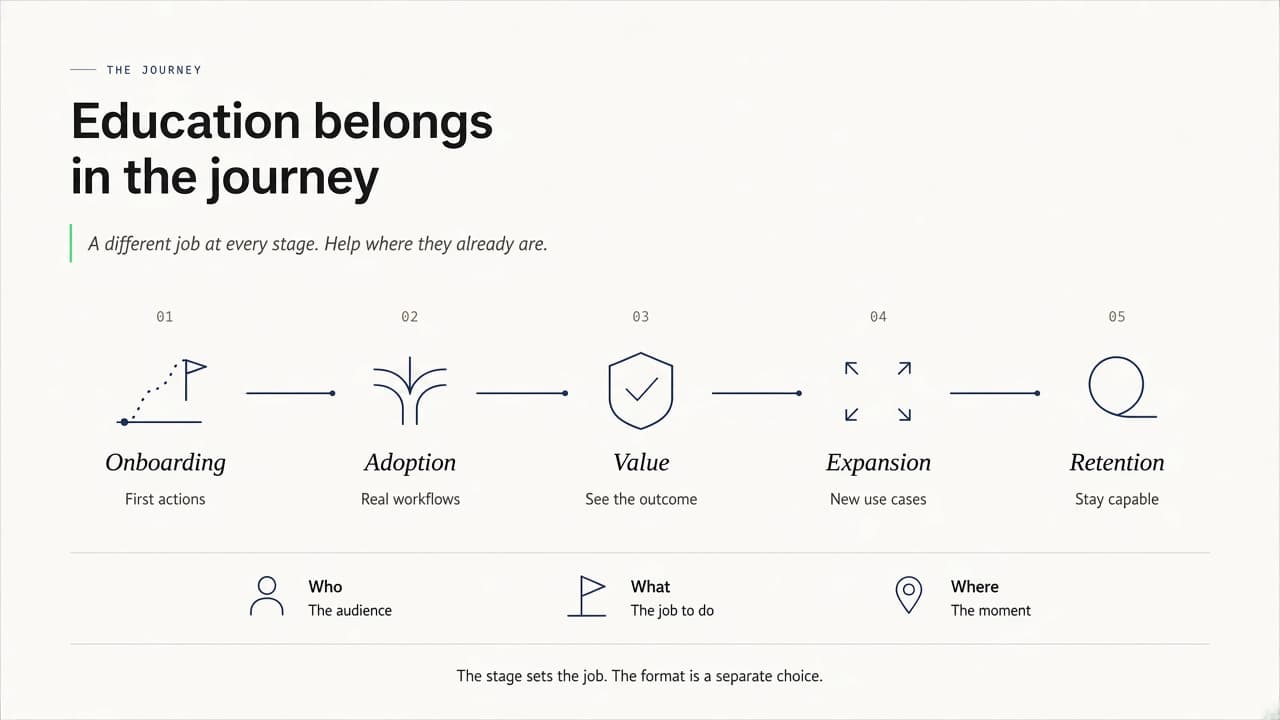
Education Has a Different Job at Each Stage of the Journey
Once the scope is clear, the next question is what education needs to accomplish at different points in the customer journey.
Onboarding, adoption, value realization, expansion, and retention aren't simply labels for different periods of time. They represent different levels of familiarity and trust, and each stage asks something different of the customer.
Onboarding might be about building confidence and getting someone into the platform to perform a few key actions quickly. The goal is to help them get started and establish the foundation for successful use.
Adoption is different. Now the customer may need to understand additional workflows or capabilities and incorporate them into the way they actually work.
Value realization is different again. At that point, the question isn't simply whether the customer knows how to use the product. It's whether they're using the capabilities they paid for, whether those capabilities are helping them accomplish the work they care about, and whether they can recognize and communicate the value they're receiving.
Expansion can introduce another set of educational needs. Customers may need to understand new use cases, capabilities, or workflows before they can broaden their use of the product.
The education job changes as the customer moves through the journey.
That doesn't mean every company needs a separate education program for every stage. It means the team needs to understand what the customer needs to accomplish at each point before deciding what content or experience to build.
Don't Confuse the Customer's Stage With the Delivery Method
There is another distinction that is important when designing a Customer Education strategy: the stage of the journey and the modality are two separate decisions.
Onboarding can be live. It can be self-paced. It can happen in the product. It can happen through email. The same is true for adoption, value realization, expansion, and retention.
There is no inherent reason that one stage has to use one particular delivery method.
The modality should be determined by the experience you need to create and what your organization can realistically support. Live education can provide a more intensive and interactive experience, but it requires people and time. Self-paced education can scale further, but the customer has to find it and engage with it independently. In-product education can meet someone directly in their workflow, but it isn't necessarily the right format for every learning objective.
There are other possibilities too. Education can be delivered through social content, email, webinars, podcasts, or even text messaging.
One example encountered was an AI coaching platform for founders and executives that primarily delivered its coaching through text messages. Instead of requiring people to open an app to get value, it sent prompts directly to them and let them engage with their AI coach through the same channel.
The interesting part wasn't that text messaging was somehow a better education format.
It was that the company had removed the requirement for the customer to go find the experience.
That is an important principle for Customer Education. The stage tells you what the customer needs to accomplish. The modality is a decision about how you can deliver that experience effectively, at the scale and level of intensity your organization can support.
Riverside Shows What Connected Education Can Look Like
Riverside.fm is a good example of what happens when education is treated as part of the broader customer experience rather than as a standalone destination.
Inside the product, Riverside uses strategic notifications to introduce new features and provide high-quality tutorials when customers are encountering those capabilities. There is also a "Watch Tutorials" path that connects users to Riverside Academy, where content is organized into different paths and tracks based on audience and goals.
But the education doesn't stop at the Academy.
Riverside also publishes much of this material on YouTube, which gives the content a social and discovery function. The company's main website surfaces Riverside University alongside the blog, free tools, webinars, and other resources. The education is connected to the main company experience rather than hidden away from it.
There is also an interesting decision in what Riverside doesn't emphasize. The Academy isn't structured around formal certification. The goal is to help people become comfortable with the product, understand video workflows, and accomplish things like recording podcasts or hosting webinars.
Certification can be a valuable objective, but it is different from education designed primarily to drive adoption and comfort with a product. The infrastructure and experience you build should reflect the outcome you're actually trying to create.
Riverside is not necessarily a model that every company should copy. But they present useful lessons in the intentionality behind the system. Education appears in the product, on the website, on social channels, and in structured learning paths because the company has treated those experiences as connected rather than independent.
The Next Evolution Is Education in the Flow of Work
Anthropic and Claude point toward another version of the same idea.
Anthropic University provides a structured education experience, with learning paths designed around different ways of using Claude. But Claude itself can also teach the user how to do something directly within the workflow.
That creates an interesting shift.
Traditionally, if you didn't know how to do something in a product, you might search the help center, find an article or video, learn the process, and then return to the product to try it.
An AI product can increasingly collapse those steps. It can explain how to accomplish something, help the customer think through the options, answer questions about the process, and potentially offer to perform the task itself.
That's a different kind of education experience.
The product isn't just pointing customers toward learning. It is becoming part of the learning environment.
This may be particularly powerful for products that have traditionally required customers to learn complex workflows before they can get value. Instead of asking the customer to leave the workflow to acquire the knowledge they need, the product can help close the gap between knowing and doing.
That is still evolving, and the exact application will differ by product category. But the underlying expectation is worth paying attention to: customers increasingly expect help to be available where they are, rather than having to leave the experience to find it somewhere else.
Build Education Into the Journey
Customer Education doesn't need to be everywhere.
It needs to be connected.
The first question shouldn't be, "What courses should we build?" It should be, "Who are we educating, what are they trying to accomplish, and where in their journey do they need help becoming capable of doing it?"
From there, the decisions become much clearer.
A prospect may need broader education that builds trust and helps them understand a problem.
A new customer may need structured onboarding that gets them to a few important actions quickly.
An existing customer may need workflow education that increases adoption or help understanding how to use more of what they've already purchased.
Those experiences might live in an Academy. They might live inside the product. They might show up through email, YouTube, social content, live sessions, or something as simple as a well-timed notification.
The format isn't the strategy.
The customer's stage, their needs, and the outcome you're trying to create should determine the strategy.
This is where Customer Education becomes part of the customer journey rather than a separate content library. The goal isn't to create an impressive collection of courses that customers can theoretically access. The goal is to make education available at the moments when it can actually help someone move forward.
Product documentation has already taught us this lesson. The best help is often the help that appears when you need it, in the context where you need it.
Customer Education has the opportunity to work the same way.
The fix for an education program that isn't reaching customers usually isn't more content. It's better architecture: clearer ownership, clearer audience definition, stronger connections to the customer journey, and a deliberate decision about where and how education should appear.
Education works best when customers don't have to go looking for it.
It's simply there when they need it.
Ready to connect customer education to the journey? Book a strategy call to decide who you're educating, what they need to accomplish, and where that help should appear.