

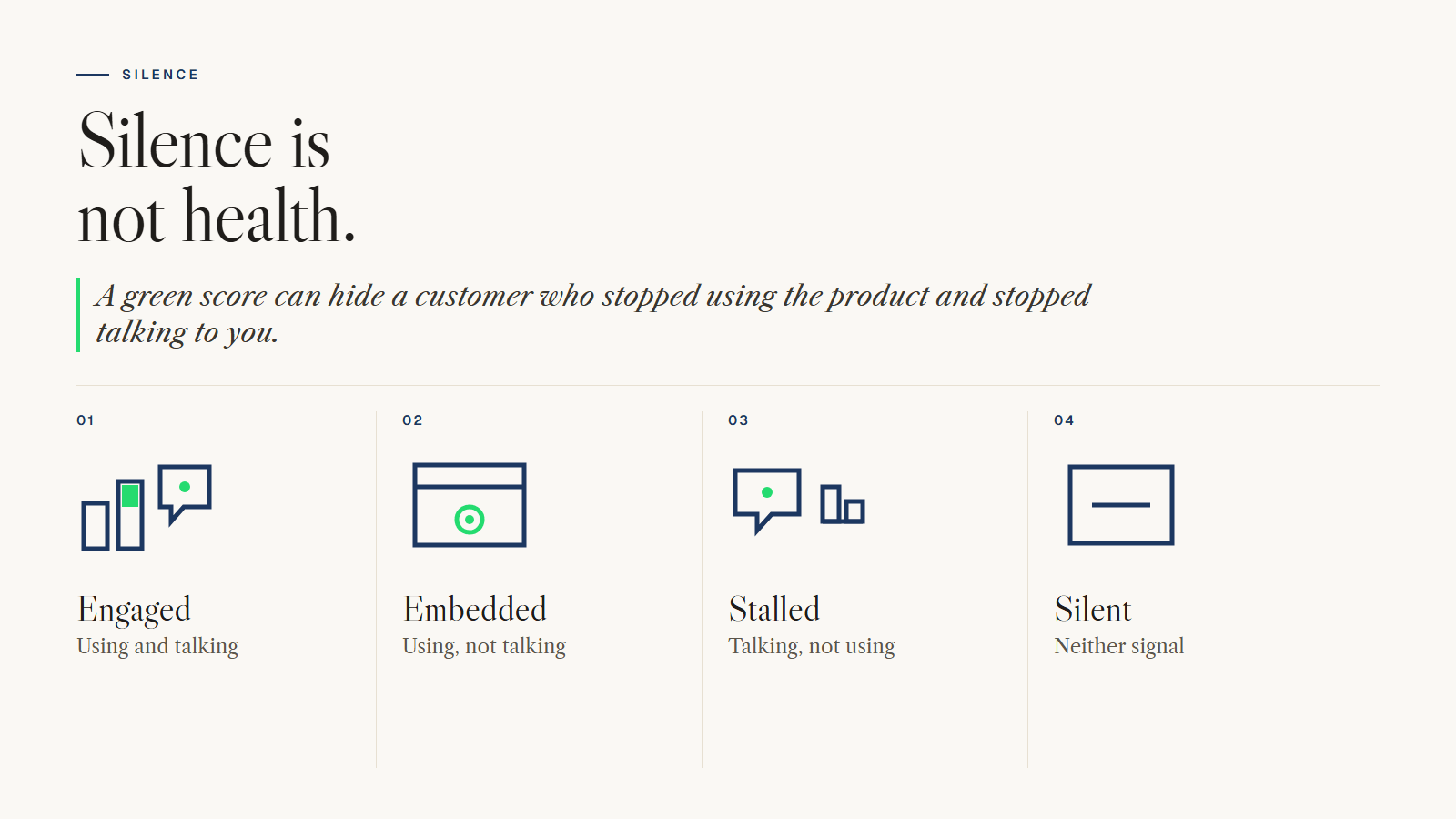
The customers who worry us most aren't always the ones complaining. Sometimes, they're the ones we haven't heard from in months.
There's a particular kind of churn that catches Customer Success teams off guard.
The account looks healthy. There are no open support tickets, no recent complaints, and no obvious escalation. The customer hasn't been asking for help or raising concerns. The health score is green.
Then the renewal comes around, and the customer decides to leave.
The team is surprised. Nobody saw it coming. There were no major incidents, no difficult conversations, and no clear warning signs in the dashboard.
But was the account actually healthy?
One of the biggest mistakes in Customer Success is treating the absence of problems as evidence that everything is going well. A customer who isn't submitting support tickets might be perfectly happy. They might also have stopped engaging because they've lost interest, aren't getting value, or have already started looking for another solution.
Silence can mean very different things.
And if your health score can't distinguish between them, you may be overlooking an entire segment of accounts that deserves attention. Why a health score isn't predicting churn starts with accounts that look busy and still leave, because the score is counting activity instead of outcomes. This is the quieter version of the same problem. The inputs never move, because the customer has stopped giving you any.
Silence Isn't Always a Good Sign
Not every quiet customer is an at-risk customer.
Some customers become so familiar with a product that they rarely need assistance. They've incorporated it into their daily workflows, know how to solve common problems, and don't need frequent conversations with their Customer Success Manager.
These are often deeply embedded customers. Their lack of communication isn't necessarily disengagement. It can be a sign that the product is doing its job.
But there's another kind of silence.
A customer stops logging in. Nobody submits support tickets. Emails go unanswered. Meetings become difficult to schedule, and eventually, the relationship seems to disappear.
The difference between these two customers is significant, but a traditional health score might not capture it.
If the score relies on historical data, contract information, or other indicators that haven't changed, an account can remain green even after the customer's behavior has changed dramatically.
This is how teams end up celebrating healthy accounts that are quietly moving toward churn.
The important question isn't simply whether a customer is communicating. It's whether they're still using the product and whether there's evidence that the relationship remains active.
Look at Usage and Communication Together
A useful way to identify silent customers is to compare two signals: product usage and customer-initiated communication.
The first is relatively straightforward. When was the last time someone from the account logged into the product?
The second requires a broader view. When was the last time the customer initiated contact with your company?
That doesn't just mean support tickets. It could be an email, a phone call, a community post, participation in a webinar, or another meaningful interaction.
Looking at these two signals together gives Customer Success a much better starting point for understanding what's happening inside an account.
There are four possible patterns.
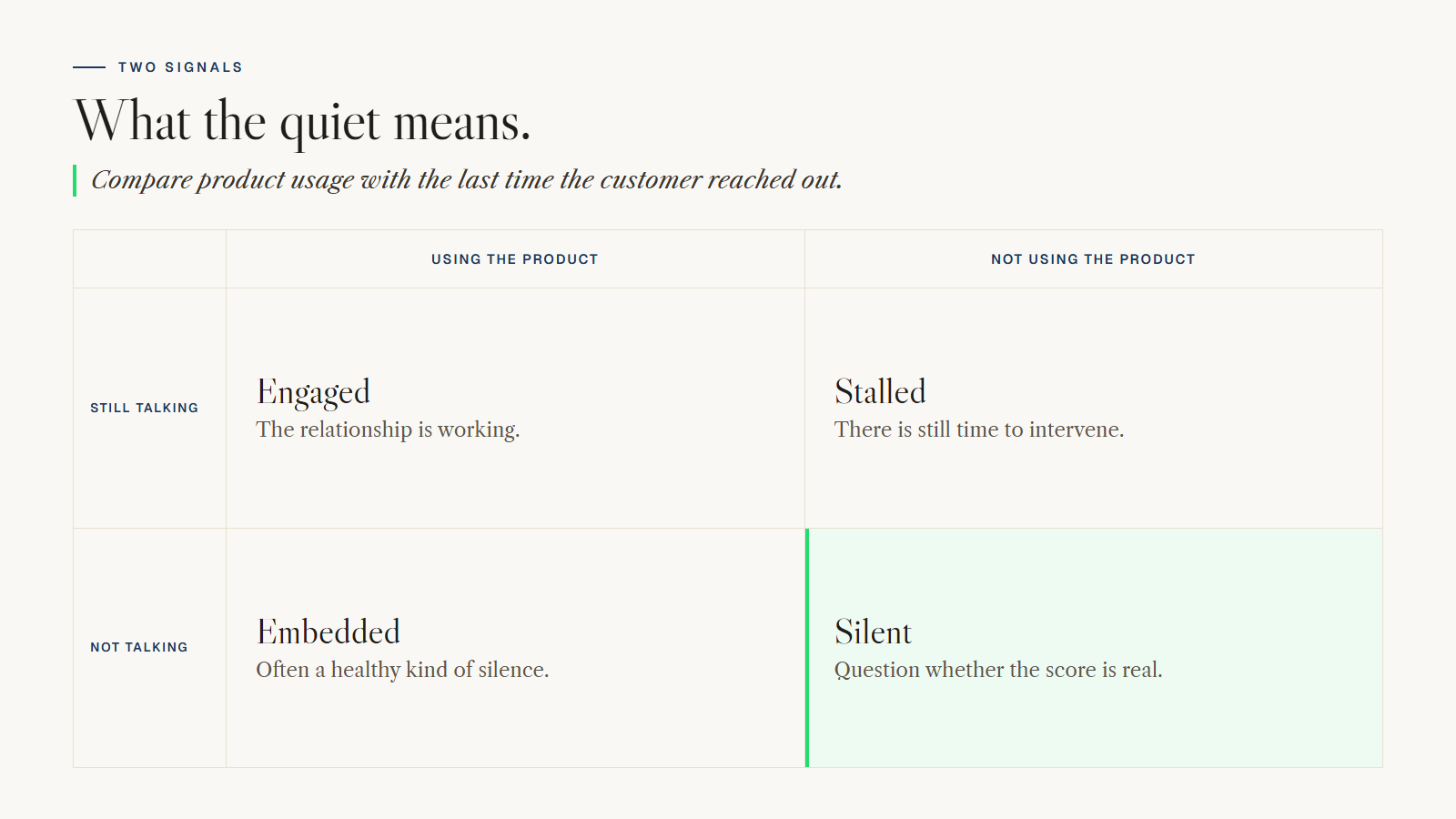
1. They're using the product and communicating with you
This is the most straightforward scenario. The customer is active, and the relationship is functioning. There are visible signs of engagement on both sides.
2. They're using the product but aren't communicating with you
This is often a healthy kind of silence. The customer may have become self-sufficient and integrated the product into their normal operations.
They might not need support or regular check-ins because they're already getting what they need.
That doesn't mean you should ignore them. Education, relevant product updates, and communications that help them discover additional value can strengthen the relationship without forcing unnecessary interactions.
3. They're not using the product, but they're still communicating with you
This is an important opportunity for intervention.
Perhaps adoption has stalled, a key workflow isn't working, or the customer has encountered a problem that hasn't been resolved. Whatever the reason, the fact that they're still reaching out means there's an opportunity to understand what's happening.
This is where proactive Customer Success can make a meaningful difference.
Rather than waiting for usage to recover, the team can investigate the underlying issue, reconnect the product to the customer's goals, and develop a plan to get adoption moving again.
4. They're not using the product and they're not communicating with you
This is the segment that deserves the most attention.
There is no visible product activity and no meaningful inbound engagement. The customer isn't asking questions, requesting assistance, or showing signs of participating in the relationship.
It doesn't automatically mean they've decided to churn. But it should make you question whether the account is genuinely healthy.
They may have lost confidence in the product, found an alternative, experienced an organizational change, or simply stopped seeing a reason to use what they purchased.
By the time renewal arrives, the decision may already have been made.
The challenge is identifying that situation early enough to do something about it.
Sometimes, the Customer Isn't the Only One Being Silent
There's another kind of silence that's even easier to overlook.
It's not coming from the customer. It's coming from your own organization.
Think about how much information your frontline teams collect every day. Support agents hear complaints. CSMs pick up on concerns during meetings. Account managers notice changes in responsiveness. Sales teams hear comments that might reveal dissatisfaction or a shift in priorities.
Individually, these interactions might not look particularly alarming.
But over time, they can reveal a pattern.
A customer repeatedly mentions that implementation hasn't delivered the expected results. Another expresses frustration with a particular workflow. An executive questions the value of the investment during a call. A champion hints that leadership is reconsidering the relationship.
These signals often remain scattered across support tickets, call recordings, CRM notes, and individual conversations.
The people closest to the customer may recognize that something is wrong, but the information doesn't always reach the people responsible for managing the account strategically.
That's a serious visibility problem.
An organization can have plenty of customer data and still lack a clear understanding of customer sentiment.
This is one area where AI can become particularly useful. When customer success platforms, CRMs, support systems, and conversation intelligence tools are connected, AI can help identify recurring themes and emerging concerns across accounts.
Instead of relying exclusively on someone to manually review every interaction, teams can use these tools to surface patterns in customer feedback, identify accounts showing signs of dissatisfaction, and bring important signals to the attention of the right people.
The technology doesn't replace the judgment of a CSM. It helps ensure that important information doesn't disappear inside disconnected systems.
Don't Just Check In. Give Them a Reason to Respond.
Once you've identified a silent account, the next question is what to do about it.
The natural reaction is often to send another email.
"Just checking in."
"How are things going?"
"Let us know if you need anything."
But if a customer has already stopped engaging, another generic check-in is unlikely to change much.
A better approach starts with understanding the customer's history.
What were they trying to accomplish when they purchased the product? Which workflows were they using? When did activity begin to decline? Were there unresolved concerns or changes in the organization? What has happened since the last meaningful interaction?
The goal is to identify a reason for the disengagement before deciding how to approach the customer.
And when you do reach out, bring something of value to the conversation.
It could be a recommendation based on their usage, a relevant feature they haven't adopted, an idea for improving an existing workflow, or a way to address a business challenge they previously discussed.
The point is to make the interaction useful rather than simply reminding the customer that you're available.
This also changes the role of the CSM.
Instead of chasing a response, they're approaching the conversation as a consultant: asking questions, uncovering objections, understanding what has changed, and helping the customer evaluate whether the product is still delivering the results they need.
Not every silent account will be recoverable, and not every account deserves the same level of intervention. The potential value of the relationship, the likelihood of recovery, and the resources required all matter.
But without understanding what's happening, you're making those decisions blindly.
Your Health Score Needs to Be Tested Against Reality
If customers are churning while still showing green, the problem might not be the customers. It might be the way you're measuring their health.
A health score is only useful if it reflects what actually happens to your accounts.
One practical way to evaluate it is to look backward.
Take your last ten churned accounts and examine what their health scores looked like approximately 90 days before they left.
How many were green? How many were yellow? Were there changes in product usage that weren't reflected in the score? Had communication stopped? Were there concerns buried in support tickets or customer conversations that never made it into the account's overall health assessment?
This exercise can reveal gaps that aren't obvious when you're only looking at current customers.
You might discover that your scorecard gives too much weight to historical activity, misses changes in engagement, or doesn't account for customer sentiment. You might also find that the data needed to identify these patterns exists but isn't being brought together.
The objective isn't to create a perfect health score. No scorecard will predict every churn event.
It's to understand which signals your current model is missing and improve your ability to recognize risk before it becomes a renewal problem.
The Accounts You're Not Hearing From Deserve Attention Too
Customer Success teams naturally spend a lot of time with customers who ask for help, raise concerns, or request meetings.
Those interactions are visible. They create activity, generate tasks, and give the team something concrete to respond to.
Silent customers are different.
They don't necessarily create work for your team, which makes it easy to assume there's nothing to worry about.
But the absence of a support ticket isn't proof of satisfaction. And a green health score isn't proof that a customer is getting value.
Some quiet customers are perfectly healthy. Others are slowly disengaging, and the difference matters enormously.
The first step is learning to distinguish between the two. The next is making sure that important signals don't get lost inside your organization.
Because by the time a silent customer tells you they're leaving, the decision may have been made long before the conversation ever happened.
The goal isn't to make every customer talk to you more. It's to know when their silence means something is wrong.
Ready to tell healthy silence from a customer already leaving? Book a strategy call to read usage and communication together before renewal.