

When customers stop responding, the biggest risk isn't always that they're unhappy. It's that your team has no idea what's happening.
Every Customer Success team has them.
The accounts that don't respond to emails. The customers who repeatedly miss scheduled calls. The contacts who stop answering messages, even when renewal is approaching.
The CSM follows up once. Then again. Maybe they try another channel or reach out to a different contact.
Nothing.
Eventually, the account gets pushed down the priority list. There are other customers who need attention, open issues to resolve, and meetings to prepare for. The unreachable account remains in the CRM, its renewal date gets a little closer, and nobody has a clear picture of what's happening.
Then the customer cancels.
Sometimes the decision was made months earlier. Sometimes the customer is still using the product but sees no reason to speak with the vendor. And sometimes, the relationship has simply faded because nobody on either side has made it a priority.
The problem is that Customer Success teams often discover the outcome only when it's too late to influence it.
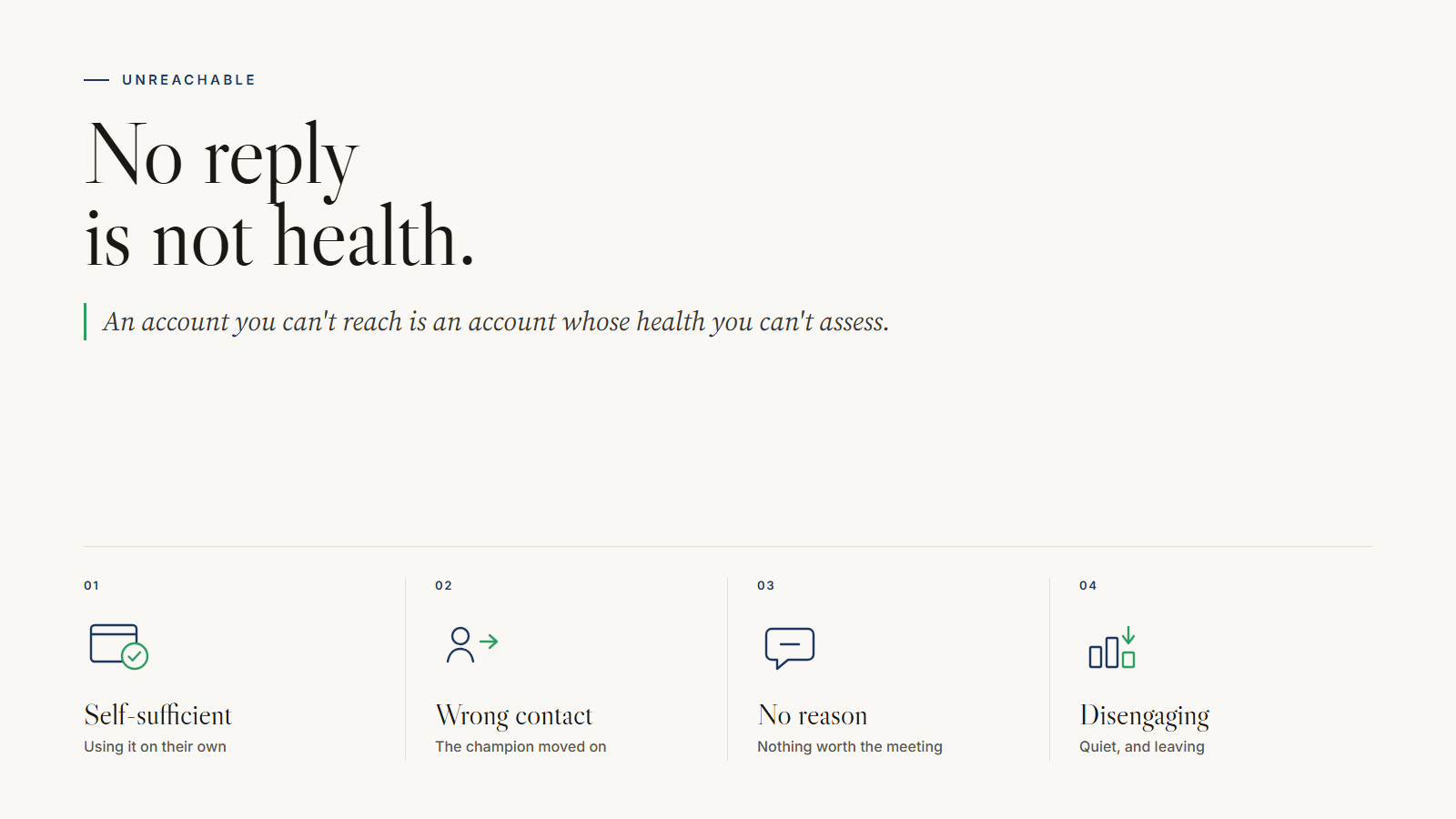
An account you can't reach isn't necessarily an account that's healthy. It's an account whose health you can't confidently assess.
Why green accounts with no tickets still leave is the version of this problem you can still see in the product. A customer stops talking, usage may have stopped with them, and the health score stays green. When you cannot reach the account at all, you lose even that. You no longer know which kind of silence you are looking at.
Not Every Customer Needs High-Touch Attention
This problem becomes especially visible when a team manages a large book of business.
There simply isn't enough time for every account to receive weekly calls, personalized check-ins, and proactive one-on-one support. Customer Success teams have to make decisions about where their time will have the greatest impact.
Larger accounts with complex implementations, significant expansion potential, or upcoming renewals will naturally receive more attention.
Smaller accounts often operate under a different coverage model.
They might receive automated communications, periodic business reviews, educational resources, or occasional outreach rather than a dedicated CSM relationship.
There's nothing inherently wrong with that approach.
The mistake is assuming that lower-touch coverage means less need for oversight.
A smaller account might represent less revenue individually, but a portfolio of hundreds of smaller accounts can represent a meaningful portion of recurring revenue. If those accounts are left without a consistent engagement and renewal process, the cumulative impact can be substantial.
The answer isn't to give every customer the same amount of attention.
It's to make sure every customer has some level of visibility, ownership, and protection against being forgotten.
Why Customers Become Unreachable
Before deciding what to do about an account that won't respond, it's worth understanding why the customer might have gone quiet.
There are several possibilities, and they don't all indicate the same level of risk.
The customer is self-sufficient.
Some customers have already adopted the product, incorporated it into their workflows, and don't need regular assistance. They may not see much value in recurring check-in calls because everything is working as expected.
In this situation, the lack of response to a meeting request isn't necessarily a problem. The more important question is whether product usage and business outcomes remain healthy.
Your contact is no longer the right person.
People change roles, leave companies, or move into different responsibilities. A relationship that once depended on a single champion can become difficult to maintain when that person is no longer involved.
Sometimes, the CSM isn't failing to reach the customer. They're simply trying to reach someone who is no longer responsible for the relationship.
This is one reason why relying on a single point of contact creates unnecessary risk.
The customer doesn't see enough value in the relationship.
Customers have limited time, and they prioritize conversations they believe are worth having.
If every interaction feels like a routine check-in, a product update, or an invitation to another meeting, they may stop responding.
This doesn't necessarily mean they're unhappy with the product. It may mean they don't see a compelling reason to spend time with your team.
The customer is disengaging.
This is the possibility that deserves the most attention.
Adoption might have declined. Their original business priorities may have changed. They may be dissatisfied but unwilling to invest time in explaining why.
Or they could already be evaluating another solution.
By the time the renewal conversation arrives, the customer may have made up their mind.
The challenge is that all four scenarios can look remarkably similar from the CSM's perspective: unanswered emails and missed meetings.
That's why simply counting outreach attempts isn't enough. Teams need other signals to understand what might be happening inside the account.
The Problem Isn't Always Outreach. It's the Lack of a System.
When a customer stops responding, the usual reaction is to try again.
Send another email. Leave a voicemail. Schedule another meeting. Try a different contact.
Those actions can be useful, but they don't constitute an account management strategy.
What happens after the third unanswered email? Who owns the next step? Does anyone check whether the account is still using the product? Is the renewal date visible to the right people? Does the account automatically receive additional attention as renewal approaches?
If the answer depends entirely on an individual CSM remembering to follow up, there's a good chance some accounts will eventually fall through the cracks.
A more reliable approach is to establish a basic coverage system for every account, regardless of its service tier.
At a minimum, that system should include four things.
1. Clear ownership and renewal visibility
Every account should have an identifiable owner or team responsible for monitoring its status, even if it doesn't receive dedicated CSM coverage.
Renewal dates, contract information, and important account changes should be visible and maintained. An account shouldn't become invisible simply because nobody is actively scheduling meetings with it.
2. Defined engagement and escalation triggers
Teams need to establish what happens when a customer stops responding.
For example, a certain number of unanswered outreach attempts, a prolonged decline in product activity, or an approaching renewal with no confirmed customer contact could trigger an escalation.
The exact thresholds will vary by business and customer segment. The important thing is that the next step is defined before the account becomes a problem.
3. Multiple contacts within the organization
If your entire relationship depends on one person, you're exposed to unnecessary risk.
Maintain relationships with multiple stakeholders where appropriate. Keep contact information current, understand who owns the product internally, and identify who is involved in purchasing and renewal decisions.
When your primary contact disappears, the relationship shouldn't disappear with them.
4. A consistent follow-up and escalation process
Automated outreach and scheduled reminders can help ensure that accounts don't get forgotten.
If repeated attempts fail, the account can be routed to the appropriate person or team, whether that's the CSM, account manager, renewals team, or billing department.
This is particularly important for smaller accounts where individual attention may not be economically practical.
The objective isn't to create more administrative work. It's to make sure that every account has a defined path when normal engagement breaks down.
Stop Measuring Attempts. Start Measuring Coverage.
There's another important distinction here.
A CSM might report that they've sent five emails, made three calls, and attempted to schedule two meetings with an account.
That's activity.
But it doesn't necessarily tell leadership whether the account is being managed effectively.
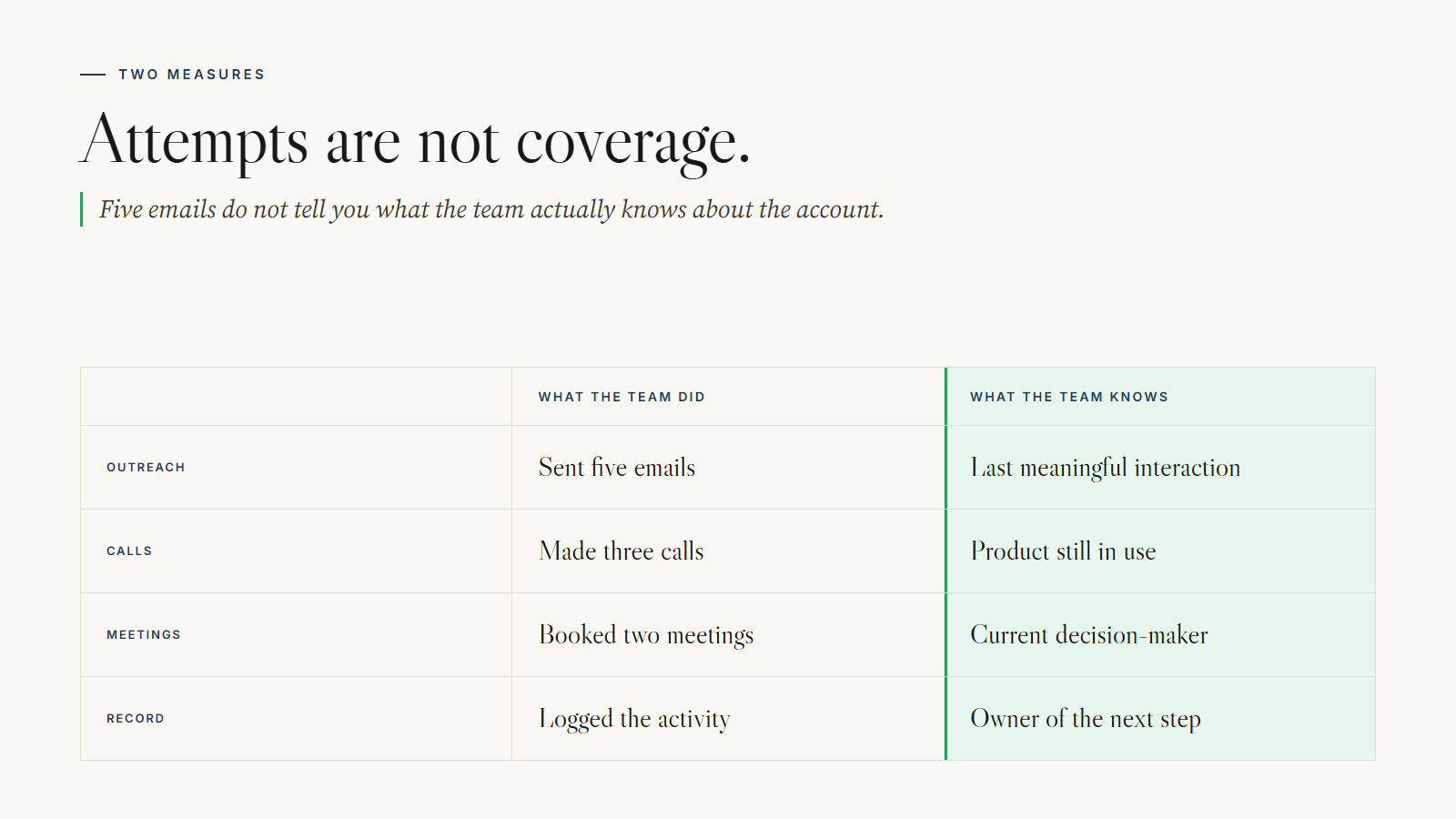
A better way to evaluate coverage is to ask what the team actually knows about the customer.
When was the last meaningful interaction? Is the product still being used? Do we know who the current decision-maker is? Has the customer confirmed their priorities? Is there a clear renewal plan? Does someone own the next action?
These questions shift the conversation away from the number of outreach attempts and toward account visibility.
It's also worth distinguishing between an attempted interaction and a meaningful one.
Sending an automated email doesn't mean you've established contact. Leaving a voicemail doesn't mean you've confirmed the customer's intentions. And a meeting invitation that goes unanswered doesn't tell you whether the customer is satisfied.
For teams managing hundreds or thousands of accounts, this distinction matters.
You don't necessarily need a live conversation with every customer every month. But you should know which accounts are engaged, which are self-sufficient, which are showing signs of disengagement, and which have become difficult to assess.
That is a much more useful picture of your portfolio.
When Silence Becomes a Renewal Risk
The closer an account gets to renewal, the more dangerous prolonged silence can become.
If a customer hasn't responded in several months, the renewal team shouldn't discover that fact for the first time 30 days before the contract expires.
Renewal readiness needs to be monitored well before the renewal date.
That means identifying accounts with no recent meaningful interaction, checking product adoption and usage trends, confirming that key contacts are still involved, and escalating accounts where the team cannot establish a clear picture of customer health.
For some customers, this might lead to a targeted re-engagement campaign.
For others, it might mean involving an account manager or executive sponsor. In some cases, a billing or renewal specialist may need to confirm whether the customer intends to continue.
And sometimes, the team will discover that the customer has already decided to leave.
That isn't always preventable.
But finding out earlier gives the business more time to understand why, assess the potential for recovery, and avoid being surprised by the same pattern across other accounts.
It also creates an opportunity to learn from customers who quietly churn. Were they genuinely self-sufficient? Did they stop using the product? Did the original champion leave? Did the company fail to establish value beyond the initial purchase?
Those answers can improve how the organization manages its entire customer base.
You Can't Afford to Let Accounts Disappear
Customer Success isn't only about managing the customers who show up to meetings, submit support tickets, and actively ask for help.
It's also about maintaining visibility into the accounts that don't.
Not every customer will respond to outreach. Not every relationship can be saved. And not every account justifies the same level of attention.
But every account should have a defined owner, a renewal process, and a system that identifies when engagement breaks down.
The alternative is allowing customers to drift until a cancellation notice makes the problem impossible to ignore.
You don't need to talk to every customer all the time. But you do need to know when you've lost touch with them, why it matters, and what happens next.
Because the accounts you can't reach shouldn't be the accounts your organization forgets.
Ready to find the accounts your team has lost touch with? Book a strategy call to put an owner, a renewal view, and an escalation path on every account.