


Your customers are logging in every day. They're using features. And they're still churning.
This is the retention paradox that most B2B SaaS companies refuse to confront: high usage does not mean high value. A customer can live inside your platform and still not be able to articulate a single business outcome it drives. And when procurement circles back to evaluate the contract, "we use it a lot" is not really a defensible answer.
The problem isn't a bad product.
The problem is an entire retention strategy built around the wrong signals. Teams are generally measuring "activity" when they could and should be measuring "impact."
This is what led us to develop the Retention Architecture framework — a systems-level approach to understanding where and why customers actually leave.
Most Retention Strategies Are Looking in the Wrong Place
The default playbook for customer retention goes something like this: invest heavily in onboarding, track usage metrics, flag accounts that go dark, and scramble at renewal time.
It works, sometimes.
Specifically, it works in environments where the buying decision is low-friction: freemium models, product-led growth motions, monthly subscriptions. In those contexts, activation is the critical zone. Get people into the product quickly, show them value fast, and you'll retain a meaningful percentage.
But this playbook falls apart for annual and multi-year enterprise deals. These aren't click-to-buy transactions. They're crafted, negotiated agreements where the renewal decision depends on one thing: provable ROI.
And provable ROI requires something many CS teams aren't equipped to deliver.
The Six Zones of Retention Architecture
Retention doesn't break in one place. It breaks down across six interconnected zones, each with specific thresholds that unlock (or block) the next stage of the customer relationship.
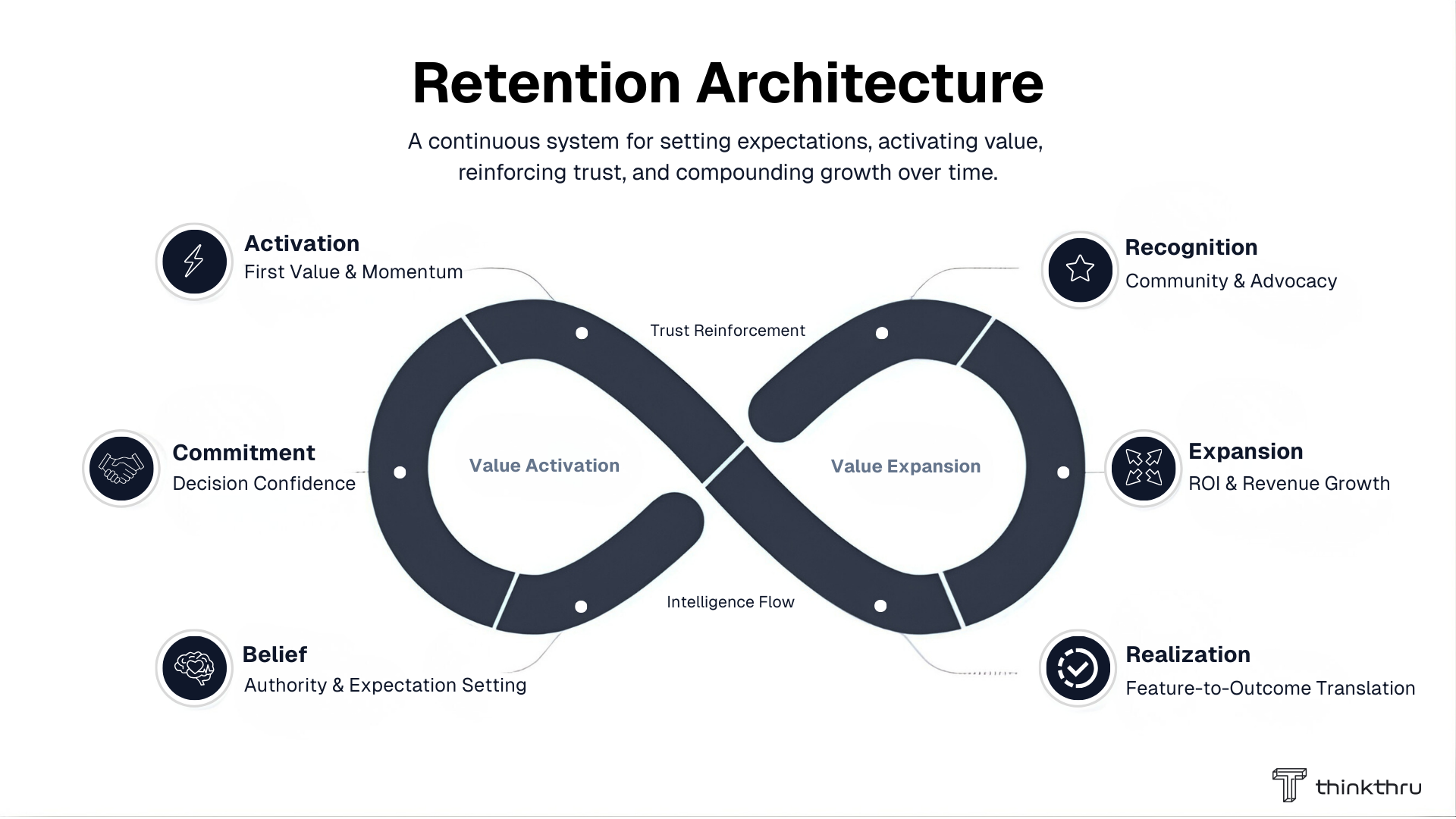
Belief is where it starts. Customers buy for the wrong reasons — misaligned expectations, oversold capabilities, or a solution that doesn't match the actual problem. When Belief is broken, everything downstream is compromised before the relationship even begins.
Commitment is where buyer's remorse lives. The contract is signed, but momentum stalls. Stakeholders second-guess the decision. Internal alignment fractures. If you lose Commitment, activation becomes an uphill battle against organizational resistance.
Activation is the zone everyone focuses on — the onboarding experience. And it matters. For PLG and monthly subscription models, this is where the largest portion of churn originates. Get activation right, and you solve a real problem.
Realization is where enterprise deals go to die. This is the zone where customers need to not just use the product, but prove it's working. Usage metrics alone can't do this. Realization requires defined outcomes, measurable impact, and the ability to articulate that impact internally.
Expansion depends entirely on Realization. You can't expand seats, use cases, or contract value without first demonstrating that the current investment is paying off. Expansion without Realization is just upselling into dissatisfaction.
Recognition is the often-invisible zone where wins happen — but nobody notices. A customer achieves a meaningful outcome through your platform, but it's never captured, celebrated, or communicated. Unrecognized value is functionally the same as unrealized value.
Connecting all six zones are Trust and Intelligence. Trust is the relationship layer. Intelligence is the data layer. Together, they make retention predictable instead of reactive.
When one zone breaks, the entire system starts to fail. These aren't isolated failures — they're systemic. You can nail activation and still lose the customer in Realization. You can prove ROI and still churn because Recognition never happened (and internal champions moved on without ever advocating for renewal).
The Realization Gap Is Killing Enterprise Retention
For many teams, the Realization zone is where the system is at the most risk.
Here's how it typically plays out. A CS team relies on in-platform analytics to gauge account health: logins, daily active users, etc. These metrics paint a picture of engagement. And engagement feels like value.
But engagement and value are not the same thing.
A customer can have high daily usage and still drive no meaningful business outcome from the platform. Or, they're driving outcomes, but nobody can articulate what those outcomes are. Both scenarios lead to the same result: when the renewal conversation happens, there's no defensible case for the investment.
This creates a downstream problem for Expansion. If you can't demonstrate Realization, you can't credibly propose expanding the relationship. You need internal champions who can tell the story of how value is being delivered. Those champions need data, language, and frameworks to make that case inside their organization.
The CS team's job, then, isn't just ensuring customers use the product. It's ensuring customers can prove the product delivers value.
From Software Vendor to Strategic Partner
This shift in responsibility requires a fundamental change in how CS operates.
Most customer success functions today are built around ticket management. They handle support requests, create help documentation, and run periodic check-ins. Some are more sophisticated, with health scores and playbooks. But the core operating model is still reactive.
The Retention Architecture demands something different. It requires CS to function more like strategic consulting than account management.
What does that look like in practice? It means:
- Defining what success looks like for each account before the engagement begins
- Putting clear targets on paper that everyone agrees to
- Designing paths to outcomes, not just monitoring usage
- Actively tracking progress against those targets throughout the relationship
I've seen exceptional account managers and change management consultants do this intuitively: they define success criteria, set expectations, and build accountability into the relationship from day one. The opportunity is to systematize that approach across the entire post-sale organization.
This is a genuine partnership — a commitment to another business's success. It's categorically different from managing a line item in a spreadsheet that's expected to renew.
The Death of "Mailbox Money" SaaS
Three forces are converging to make this shift not optional but existential.
First, economic pressure. Today's environment demands that every dollar of SaaS spend is justified. The days of running three marketing platforms, two CRM tools, and a handful of attribution systems because "we still have the contracts" are ending.
Teams are being forced to stand up and justify spend — sometimes risking their positions on the recommendation. Intelligence and analysis tools are getting smarter, and leadership wants a clear picture: for every dollar in, how many dollars out?
Second, the build-vs-buy equation is changing. Engineering teams can deliver faster. The cost of building specific feature sets is dropping. Large-scale, off-the-shelf purchases that businesses traditionally accepted as the cost of doing business are being reevaluated. The question is no longer "can we build this ourselves?" It's "should we, given what it actually costs now?"
Third, AI is accelerating both of these trends. Teams can bridge capability gaps with AI development tools. Custom software that would have required a dedicated team for months can now be prototyped in weeks. The barrier to "just build it" is lower than it's ever been.
This means the traditional SaaS value proposition — features, compliance, and a polished UI — is no longer sufficient. If the only thing differentiating your platform is what it does, you're vulnerable to any team that decides to build it themselves.
The "mailbox money" era of SaaS — where you sell software and collect recurring revenue with minimal service overhead — is ending. Companies will be compelled to compete in the service model whether they planned to or not.
Competing on Expertise, Not Just Software
My prediction: professional services, expertise, and intellectual property delivery will become a standard part of the SaaS offering — not the exception.
This is especially true for earlier-stage companies. When a customer chooses to work with a smaller, more specialized vendor, they're not just buying a UI with buttons and APIs. They're buying the expertise that built those features. They want that knowledge brought into their business. They want a partner who can de-risk a process, not just automate it.
This doesn't mean every customer gets all-in, 100% white-glove treatment. The practical reality is a tiered model.
For lower-investment accounts, the play is tech-touch: courses, training, curriculum, and AI-driven personalized experiences that distribute expertise at scale. Think of it as professional services IP delivered through technology — so customers get the benefit of deep knowledge in the flow of their work.
For higher-investment accounts, the play is human-touch: dedicated meetings, consultation sessions, on-site strategy work. This is the traditional professional services model, but embedded within the software relationship.
Most companies will need both. Build the AI infrastructure for the tech-touch side. Develop the capacity for the human-touch side. Then deliver each based on account value and organizational capacity to serve.
The companies that figure this out will have a retention advantage that pure UI/buttons/features competitors can't replicate. The product is no longer the differentiator. The partnership is.
What This Means for Your Organization
This shift has real structural implications. Engineering budgets will partially migrate into services budgets. More people will become customer-facing and solution-oriented. The organizations that thrive will be the ones that recognize this transition early and build for it.
It may also mean rethinking pricing entirely. Usage-based and performance-based models become more viable when your value proposition is tied to outcomes rather than access. If you're confident enough in your impact to price against results, that confidence becomes a competitive signal.
The question isn't whether this shift is coming. It's whether you'll lead it or be forced into it.
Ready to find out where your retention systems are breaking down? Take the Retention Architecture Assessment and identify which of the six zones needs attention first.